You ask ChatGPT to recommend the best provider in your industry. Three competitors appear by name. Your business is nowhere in the answer. You try Perplexity. Same result. Gemini? Your competitor again, sometimes linked, sometimes with a pull-quote from their site. This is the new competitive gap, and it has nothing to do with your Google rankings.
AI search is binary. Traditional search ranks websites on a results page, so you can be on page two and still exist. AI search chooses sources: either your brand is in the answer, or it is invisible. There is no page two. Gartner projects that traditional search engine volume will drop 25% by 2026 as AI-powered alternatives capture demand, and the brands your customers find won't be decided by page-one rankings alone. They'll be decided by which businesses AI engines choose to cite.
The good news: the reasons your competitors get cited instead of you are structural, not subjective. They are measurable, testable, and fixable. This guide walks through why traditional competitor analysis misses the AI channel entirely, the five structural reasons competitors win citations, the five dimensions of a real competitive AI visibility benchmark, how to reverse-engineer any competitor, how to find exploitable gaps, and the priority order for closing the distance.
Key Takeaways
- AI search is binary: there is no page two. Either your brand is cited in the answer, or it is invisible, so competitive dynamics are fundamentally different from traditional SEO.
- Traditional competitor tools (Ahrefs, SEMrush, Moz) measure organic rankings and backlinks but reveal nothing about which brands AI engines actually cite. A competitor with weaker domain authority can dominate AI answers while your well-optimized site gets ignored.
- Five structural reasons competitors win AI citations: stronger entity signals, greater off-site authority (AirOps found roughly 85% of AI brand mentions come from external domains), content structured for AI extraction, Knowledge Graph and training data presence, and a stronger technical foundation with fresher content.
- Three types of exploitable gaps exist: topic gaps (queries where no brand gets cited), format gaps (competitors with strong content but poor AI-readable structure), and entity gaps (industries where no competitor has Knowledge Graph or Wikipedia presence).
- The competitor advantage is not permanent. Structural fixes can produce measurable AI visibility results within weeks, but every month you wait is a month your competitors extend their lead.

Why Traditional Competitor Analysis Falls Short in AI Search
Every established competitor analysis tool (Ahrefs, SEMrush, Moz, SimilarWeb) measures the same signals: organic rankings, search volume, backlink profiles, domain authority. These metrics describe traditional search competition. They reveal nothing about AI search competition.
AI engines like ChatGPT, Perplexity, Gemini, and Claude don't rank websites. They synthesize answers from training data, real-time retrieval, and knowledge graphs, then decide which sources deserve citation. The retrieval and citation mechanics behind that decision are what determine whether your brand makes the answer at all. A competitor might outrank you on Google but be completely invisible to AI. Conversely, a smaller competitor with a fraction of your domain authority might get cited consistently because their content structure, entity signals, and schema markup align with what AI engines need to recommend a brand.
The signals that determine AI visibility overlap with SEO but aren't identical. Structured data, entity recognition, content freshness, citation-worthy formatting, and knowledge graph presence all play roles that traditional competitive tools don't measure. If your competitor analysis only covers traditional search, you're optimizing for a shrinking share of how people discover businesses, and the competitors who matter most might not be the ones dominating Google. They might be the ones dominating AI answers.
The Five Structural Reasons Competitors Get Cited Instead of You
When a competitor consistently appears in AI answers and you don't, they almost always hold an advantage in one or more of these five areas. Each is addressable.
Stronger Entity Signals
AI engines need to confidently identify what a business is, what it does, and where it operates before they'll cite it. Competitors with consistent brand names, clear service descriptions, and Schema.org Organization and LocalBusiness markup across their site give AI engines a machine-readable identity. A Semrush analysis of 5 million AI-cited URLs found that Organization, Article, and BreadcrumbList schema appear most frequently on pages cited by ChatGPT Search and Google AI Mode at meaningfully higher rates than the web at large.
Consistent NAP (name, address, phone) across every platform, whether Google Business Profile, social media, directories, or your own website, reinforces the same entity. Without these signals, AI engines are effectively guessing what your business does, and guessing produces silence, not citations. Your competitor with proper schema markup is giving AI the answer on a silver platter. For a deeper walkthrough of the entity gaps to exploit, the entity-SEO playbook covers Knowledge Graph, Wikidata, and structured-identity patterns end-to-end.
Greater Off-Site Authority
According to AirOps' 2026 State of AI Search report, approximately 85% of brand mentions in AI search come from external domains, not from the brand's own website. Brands with a strong off-site presence are roughly 6.5 times more likely to earn AI visibility than those relying solely on owned content.
This is the signal most businesses underinvest in. Sites with substantially stronger backlink profiles are meaningfully more likely to be cited by ChatGPT than sites with thin profiles. Domains with active brand mentions on platforms like Reddit, Quora, and industry forums see noticeably higher citation rates. Review profiles on Trustpilot, G2, and Capterra raise the chances of being selected as a source. If your competitor is frequently mentioned on industry sites, comparison pages, and review roundups, AI engines have more evidence to cite them confidently. The full off-site authority playbook covers how to systematically earn the third-party signals that drive citation share, and the broader website authority foundations for AI search explain how trust accumulates across linked domains.
Content Structured for AI Extraction
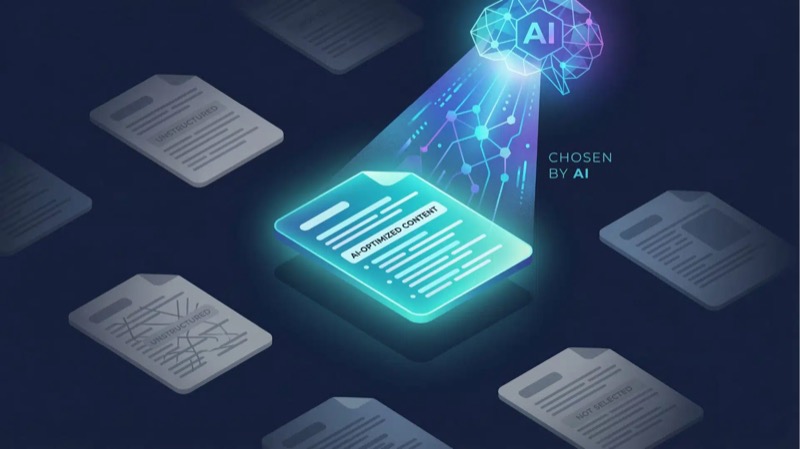
AI engines don't rank pages; they extract answers. They favor content with direct factual claims, clear headings that mirror how people ask questions, and self-contained sections that answer a specific query in 2-3 sentences. Competitors whose content answers questions in the opening sentences and follows a logical structure make it easy for AI to pull citable information.
Content that buries answers, uses vague phrasing, or relies on visual design over text structure gets skipped. This isn't about word count or traditional content quality; it's about citability. Top-performing pages in AI search cover a much broader range of relevant subtopics than bottom performers, and breadth and structure together determine whether AI engines choose your content. AI engines cite sections, not full articles, so every H2 block should make sense on its own.
Knowledge Graph and Training Data Presence
AI engines cross-reference entities against knowledge bases like Google's Knowledge Graph and Wikidata. Businesses that appear in these structured databases carry a trust signal that unstructured web content cannot match. If your competitor has a Knowledge Graph entry and you don't, AI engines have a verified reference point for them and nothing equivalent for you.
Training data presence works the same way over a longer horizon. AI models like ChatGPT and Claude are trained on web data scraped from sources like Common Crawl, which indexes billions of pages. A competitor with 50,000 pages in Common Crawl has fundamentally different AI visibility than one with 500, regardless of their Google rankings. This is a baseline visibility that real-time retrieval alone cannot match, and it is a structural advantage that cannot be replicated overnight, but can be measured and closed with consistent, high-quality publishing.

Stronger Technical Foundations and Freshness
The technical basics that many businesses treat as housekeeping (page speed, URL structure, clean HTML, crawlability) correlate directly with AI citation rates. Pages with faster load times generate higher engagement metrics, which AI models use as quality signals. According to Semrush's analysis of 5 million AI-cited URLs, descriptive URL slugs in the 17-40 character range receive the highest citation counts, while extremely short or bloated slugs appear far less often.
AI models also treat recency as a trust signal. When users compare options or make purchasing decisions, AI engines prioritize sources with up-to-date information. A competitor publishing monthly industry updates will outperform a business whose last blog post is from 2023, regardless of raw content quality. And if your robots.txt blocks AI crawlers like GPTBot, ClaudeBot, or PerplexityBot, or your WAF throws CAPTCHA walls at AI user agents, you may be actively preventing the visibility you want.
The Five Dimensions of Competitive AI Visibility Benchmarking
A meaningful competitor benchmark covers five distinct dimensions. Checking only one or two creates blind spots. For the broader set of competitive measurement dimensions, including how to design repeatable test panels, the brand-presence guide pairs well with the framing below.
AI Citation Rate
The most direct measure: when someone asks an AI engine about your industry, does it mention your brand or your competitor's? To test this, query multiple AI platforms with the same prompts and track which brands get named, how often, and in what context. Single manual tests are unreliable because AI responses vary by platform, phrasing, and timing. Systematic testing across dozens of queries reveals statistically meaningful patterns.
What to track: which competitor gets cited most frequently across platforms, whether citations are brand-level ("Acme Corp recommends...") or page-level ("According to acme.com/guide..."), and whether certain platforms consistently prefer one competitor over others. The AI share of voice metric translates these raw counts into a comparable benchmark you can track quarter over quarter, and Share of Voice vs competitors extends the same logic into off-site brand-mention coverage.
Structured Data and Schema Markup
AI engines rely heavily on structured data to understand what a business does, where it operates, and what it offers. Compare your schema implementation against competitors: do they have Organization schema with complete business details, Product or Service schema on offerings, FAQ schema on key landing pages, and is their schema valid and error-free?

Knowledge Graph Presence
Knowledge Graph entities act as identity anchors for AI models. When Google's Knowledge Graph recognizes a brand as a distinct entity with attributes like industry, founding date, location, and key people, AI engines can reference that entity with higher confidence. Search each competitor's brand name on Google and check for a knowledge panel. Competitors with established Knowledge Graph entries often carry a citation advantage because the model can verify the entity independently of any single webpage.
Training Data Footprint
Training data presence provides baseline AI visibility that retrieval alone cannot match. Check Common Crawl's CDX index to see how many pages from your domain versus a competitor's appear in training datasets. The 50,000-versus-500 gap described earlier is not hypothetical; it is the kind of structural asymmetry that decides citation outcomes before any query is even run.
Content Citability
Not all content is equally citable. AI engines prefer content that states facts clearly in 2-3 sentences, includes specific data or original research, uses clear heading structures, and attributes claims to sources. Compare the content structure of your top pages against your competitors'. If their content reads like a reference guide and yours reads like marketing copy, AI engines will cite them more often even if your domain authority is higher.
The difference is concrete. Weak: "We're the leading provider of cloud solutions for enterprises." Strong: "Our cloud platform processes 2.3 million API requests daily across 140 enterprise clients in 12 countries." The second version gives AI engines something quotable and factual. The first gives them nothing they can cite with confidence. The common mistakes brands make when pursuing AI visibility usually come down to optimizing for the wrong signals, and content citability is frequently the gap that separates the cited from the invisible.
How to Reverse-Engineer a Competitor's AI Visibility

You don't need expensive tools to start analyzing competitors' AI search presence. A disciplined five-step audit produces actionable results and slots into the broader research framework that includes competitive benchmarking when you want to repeat it as a recurring discipline.
Step 1: Identify your real AI competitors. These may differ from your traditional SEO competitors. Query ChatGPT, Perplexity, Gemini, and Claude with variations of "best [your product/service] for [your customer type]", "which [industry] companies are most trusted?", and "who should I choose for [specific need]?" Record which brands appear in each response. Run at least 10 queries per platform to see consistent patterns. The brands that AI engines cite in your category are often not the ones ranking highest on Google.
Step 2: Audit structured data. Visit the websites of the competitors that appear in AI answers. Use Google's Rich Results Test or Schema.org Validator to compare schema markup depth. Focus on Organization, Product, FAQ, and HowTo schemas, since these have the most direct impact on AI understanding. Check their content structure too: do they use FAQ sections, comparison tables, and clear factual statements?
Step 3: Test citation rates across platforms. Query at least three AI platforms with 10-15 industry-relevant prompts. Track which brands get cited, how often, and whether citations are positive, neutral, or instructional. Monitoring this over time reveals trends that single snapshots miss, and competitive citation benchmarking tooling makes platform-by-platform comparison practical at scale.
Step 4: Assess training data presence. Check Common Crawl's CDX index for indexing depth on your domain and each competitor. This reveals the baseline AI awareness each brand benefits from, independent of real-time retrieval. Brands that publish consistently and maintain updated content are more likely to appear in AI training data refreshes and real-time retrieval indexes.
Step 5: Compare content structure. Read your competitors' top-performing pages with AI eyes. Are their answers self-contained? Do they use clear, factual language? Would you cite their page if you were an AI summarizing the topic?
Running this audit manually is time-intensive, which is exactly the gap tools that automate benchmarking and comprehensive AI visibility research close. SwingIntel runs live citation testing across 9 AI platforms, analyzes structured data quality, and measures training data presence, and automatically benchmarks the competitors AI engines associate with your market, so the five-step process above is handled at a depth a manual pass rarely reaches.
Finding Gaps You Can Actually Exploit
The most valuable output of competitive AI analysis isn't knowing where competitors are strong; it's knowing where nobody is strong. In traditional SEO, every valuable keyword has entrenched competition. In AI search, entire topic areas remain unclaimed because most businesses haven't optimized for AI visibility at all.

Look for three types of exploitable gaps:
Topic gaps. Queries where AI engines give generic, hedged, or vague answers without citing any specific brand. These represent uncontested territory. If you create structured, authoritative content that directly answers these queries, you become the default citation, not through outranking a competitor, but by being the only credible source available.
Format gaps. Competitors might have strong content but poor structure. If their guides lack schema markup, their product pages miss FAQ sections, or their articles bury key facts in long paragraphs, you can win the citation by presenting the same information in a format AI agents can extract and cite more efficiently.
Entity gaps. Some industries have no businesses with strong entity signals: no Knowledge Graph presence, no Wikipedia references, no consistent structured data. Establishing your entity profile in these spaces creates a compounding advantage. Once AI engines recognize you as a known entity, every piece of content you publish benefits from that recognition.
The first-mover advantage in AI search is more pronounced than it ever was in traditional SEO. AI engines develop citation habits: once a brand becomes a trusted source for a topic, it tends to stay cited as long as the content remains relevant and updated. That's why closing these gaps earlier compounds more than closing them later.
The Priority-Ordered Fix List to Close the Gap
Once you've mapped the competitive landscape, not every fix matters equally. Some changes move the needle within weeks. Others take months to register. Here's the priority sequence based on how AI engines actually select which brands to cite.

1. Restructure Content So AI Can Extract Answers
This is the fastest fix on the list. Every page that targets a potential AI query needs clear headings that mirror how people ask questions (if someone asks ChatGPT "what's the best project management tool for small teams?", your H2 should read close to that, not "Our Solutions"), direct answers within the first two sentences under each heading, and short self-contained sections so each H2 block makes sense on its own. AI visibility research shows exactly how AI engines currently read your site and where your content structure falls short, and the restructuring is work we do rather than hand back.
2. Fix Entity Signals and Structured Data
AI engines need to understand what your business is before they can recommend it. Start with schema markup on your homepage and key landing pages: Organization, LocalBusiness, Product, or Service schemas that spell out who you are, what you offer, and where you operate. Ensure consistent NAP across every platform. Work toward Knowledge Graph presence through a Google Knowledge Panel, Wikidata entry, or Crunchbase profile that validates you as a recognized entity. This is the single fastest entity-signal fix, and the gap most competitors still haven't closed.
3. Build Citation-Worthy Content
AI engines cite sources they trust, and trust means content that contains specific, verifiable claims rather than marketing copy. The Semrush research noted earlier found cited pages are far more likely to carry Organization schema, evidence that specificity and structure travel together. Your highest-priority pages (homepage, product pages, about page, key blog posts) need specific factual statements that AI engines can extract and attribute: numbers, methodologies, proprietary data, and defined processes. Rewrite "leading provider" as "2.3 million API requests daily across 140 clients in 12 countries" wherever you can.

4. Strengthen Off-Site Authority
On-site optimization sets the foundation. Off-site authority determines whether AI engines trust you enough to cite you over competitors. Given that roughly 85% of AI brand mentions originate off-site (AirOps), this is the signal with the longest runway and the highest leverage. You don't need a massive backlink profile to start seeing results, but you do need a deliberate strategy: digital PR and expert commentary in industry publications, active presence on Reddit and Quora where your audience asks questions, review profiles on G2, Trustpilot, Capterra, and similar platforms, and consistent brand mentions that reinforce your entity identity across the web.
5. Monitor, Test, and Iterate
AI visibility is not static. AI models update retrieval sources, retrain on new data, and adjust citation behavior continuously. Set a regular cadence: monthly AI citation checks querying each major AI engine with your target keywords, competitive benchmarking to track whether your changes are closing the gap or competitors are pulling further ahead, and content freshness audits (pages untouched in six months lose citation priority). Quarterly reviews at minimum: the landscape shifts faster than traditional search, and the brands paying attention will be the ones AI engines recommend.
A Realistic Timeline to Close the Gap
Weeks 1-2: Audit your current position. Before fixing anything, measure the gap. Run the five-step reverse-engineering audit above. Manual spot-checks are unreliable on their own (AI responses vary by query phrasing, user context, and timing), so document patterns across multiple queries and platforms.
Weeks 3-4: Fix structural foundations. Implement Organization, Article, and BreadcrumbList schema on your top 10 pages. Restructure content to lead with direct answers under question-format H2s. Verify AI crawlers (GPTBot, ClaudeBot, PerplexityBot, Google-Extended) are not blocked by your robots.txt or WAF configuration. Most structural fixes in this window can produce measurable AI visibility changes within a few weeks, not months.
Month 2: Build authority signals. Pursue mentions in industry publications, contribute expert commentary, and ensure your brand has profiles on relevant review platforms. Target listicles that AI engines already cite: getting included in a list ChatGPT references is more valuable than ranking for a keyword AI bypasses entirely.
Month 3: Expand content clusters and measure. Create content around the questions your target audience asks AI engines. Monitor citation rates across platforms. AI visibility shifts faster than traditional rankings, and changes you make now can produce measurable results within weeks rather than the six-to-twelve-month timeline of traditional SEO.
Close the Gap Before It Widens
The competitor advantage in AI search is not permanent. It reflects who adapted first, and every structural gap is addressable. But AI search adoption is accelerating: Gartner's 25% traditional-search decline by 2026 isn't a distant forecast, it's happening already, and the first-mover advantage in AI citations compounds. Once AI engines form a citation habit around a source, that source tends to stay cited as long as the content remains relevant.
The businesses winning in AI search aren't necessarily the largest or the most established. They are the ones that recognized the shift first and structured their digital presence accordingly. Competitor analysis for AI search tells you exactly where you stand and exactly where the opportunity lies. Request the complete competitive picture with AI Visibility Research: live citation testing across 9 AI platforms, competitive benchmarking against the rivals AI engines associate with you, and a prioritized roadmap built for your market and then we do the work to close the gaps it names.
Frequently Asked Questions
Is AI search visibility separate from Google SEO, or do they overlap?
They overlap significantly but are not identical. Many SEO fundamentals (structured data, content quality, technical health) also drive AI visibility. However, AI engines place additional weight on entity signals, knowledge graph presence, content formatted for machine extraction, and off-site mentions across review platforms and community sites like Reddit and Quora. A site can rank well on Google and still be invisible to AI engines if it lacks these additional signals.
Why does a competitor with weaker SEO appear in AI answers when I don't?
AI engines use different signals than Google to decide which brands to cite. A competitor with weaker domain authority can get cited consistently if their content has comprehensive schema markup, clear entity definitions, and structured answers that AI systems can extract and attribute. Traditional SEO strength does not automatically translate to AI visibility: entity clarity, off-site authority, and content citability matter more.
How do I find my real AI search competitors?
Query ChatGPT, Perplexity, Gemini, and Claude with variations of "best [your product/service] for [your customer type]" and record which brands appear. Run at least 10 queries per platform. The brands that consistently surface are your real AI search competitors, and they are often not the same as the ones ranking highest on Google. A smaller business with comprehensive structured data and strong entity signals can dominate AI answers while ranking poorly in traditional search.
What is the fastest competitive gap to close in AI visibility?
Schema markup is typically the fastest gap to close: adding comprehensive JSON-LD structured data (Organization, Product, FAQ, Article) is a one-time technical implementation with lasting impact. Content citability improvements (restructuring content to lead with direct answers and specific data) are the next fastest. Training data presence is the hardest to close quickly because it builds over years of consistent publishing.
How long does it take to close the AI visibility gap with competitors?
Structural improvements like schema markup and content restructuring can produce measurable results within weeks. Building authority signals through industry publications and review platform profiles typically takes 1-3 months. Training data presence, which builds over years of consistent publishing, is the slowest gap to close, but real-time retrieval improvements (structured data, freshness, citability) can compensate while you build your long-term content footprint.
How do I find topic gaps where no brand gets cited by AI?
Query AI engines with variations of questions your customers would ask. Look for responses where the AI gives generic, hedged, or vague answers without citing any specific brand. These represent uncontested territory: if you create structured, authoritative content that directly answers these queries, you become the default citation source. This is the single highest-leverage move available in AI search because you're not outcompeting established brands; you're filling a vacuum.