Your brand now exists in two places: the traditional web that Google indexes and the AI layer that sits on top of it. When a buyer asks ChatGPT for a product recommendation, Perplexity for a service comparison, or Gemini for industry advice, your business is either part of the answer or it is not. Most companies have no idea which one is happening, and their existing analytics stack cannot tell them. AI visibility monitoring closes that blind spot by tracking how the major AI platforms represent, cite, and recommend your brand, in real time, across every engine that matters.
Key Takeaways
- Traditional analytics tools (Google Analytics, Search Console, rank trackers) cannot measure whether AI agents mention, cite, or recommend your brand. The interaction happens before any click.
- AI visibility monitoring measures five core metrics: citation rate, platform coverage, mention prominence, sentiment and context, and AI Overview presence.
- Multi-platform coverage is non-negotiable. Citation rates vary dramatically between ChatGPT, Perplexity, Gemini, Claude, and Google AI. A brand ChatGPT recommends may be invisible on Perplexity.
- The options split into three groups: subscription monitoring dashboards (Otterly.ai, Peec AI, Profound, Scrunch AI), AI visibility added to existing SEO toolsets (Semrush, SE Ranking, Ahrefs Brand Radar, Keyword.com), and research-first consultancies that map the whole picture and then fix it (SwingIntel).
- The most effective approach is audit first, then monitor: establish a cross-platform baseline with a deep diagnostic, then track changes with a lighter-weight monitoring tool.
Why Traditional Analytics Miss the AI Layer

Google Analytics, Search Console, and rank trackers were built for a world where users click links. AI search works differently. When ChatGPT answers "best project management tools for small teams," it synthesizes an answer from across the web and delivers it directly. The buyer often never visits your website, yet your brand was either recommended or overlooked.
Traditional SEO tools cannot tell you whether an AI agent mentioned your business, what sentiment it attached to your brand, or whether it cited your website as a source. This is a fundamentally different measurement problem. Gartner predicted that traditional search engine volume would drop 25% by 2026 as buyers shift to AI chatbots for product research and service recommendations, and AI-driven search experiences continue to reduce traditional organic traffic across categories.
You can rank on Google's first page and still be completely absent from AI-generated answers. Or worse, be mentioned negatively. Every day that gap goes unmeasured is a day your competitors can widen it without resistance.
What AI Visibility Monitoring Actually Measures
AI visibility monitoring is distinct from both traditional website analytics and classical social listening. Social listening scans Twitter, Reddit, and news sites for brand mentions. AI visibility monitoring tests query-response pairs across AI platforms to determine whether, how, and how prominently your brand appears in AI-generated answers.
Five core metrics define the category, and each maps to a deeper measurement framework. Each tells you something different about your presence in the AI layer.
Citation rate: the percentage of relevant queries where an AI platform mentions your brand. A business appearing in 6 out of 10 test queries for its category has a 60% citation rate. This is the headline metric: the clearest signal of whether your website is sending the right signals to AI retrieval systems. The mechanics of why citations are the central metric for AI search are worth understanding before you optimize.
Platform coverage: which AI engines cite you and which do not. Most businesses discover strong performance on one platform while remaining absent from others. That gap tells you exactly where to direct optimization efforts first, rather than applying generic changes across the board.
Mention prominence: whether you are the first recommendation, one of several options, or buried at the end of a longer list. Being cited fifth in a seven-item list is very different from being the top recommendation. Prominence correlates directly with buyer trust, in the same way Google ranking position does.
Sentiment and context: whether AI platforms describe your business positively, neutrally, or negatively, and in what context. An AI recommending your brand alongside a caveat sends a very different signal than an unqualified recommendation. Sentiment shifts also reveal when a platform has absorbed outdated or misleading information about your business.
AI Overview presence: whether your brand appears in Google's AI-generated summaries at the top of search results. These summaries now appear for a growing share of queries, and appearing in them is a distinct ranking challenge that sits outside traditional organic rankings entirely.
Beyond the core five, three secondary signals round out a complete monitoring picture:
- Source attribution: whether AI platforms link back to your content when they cite you, not just mention your brand name.
- Competitive share of voice: your citation rate relative to your top competitors for the same queries. Absolute numbers lie; relative numbers reveal.
- Content citability: how well your page structure, structured data, and factual density support AI citation in the first place.

Why Multi-Platform Coverage Is Non-Negotiable
Each AI platform uses a different combination of training data, retrieval architecture, and ranking signals. Your brand's visibility can vary dramatically from one LLM to the next. A business with strong Wikipedia presence and structured data may perform well on ChatGPT and Gemini but poorly on Perplexity, which leans more heavily on live web retrieval. A company with extensive, well-structured long-form content may dominate Perplexity but be underrepresented in Claude's responses.
The practical consequence: single-platform tracking creates blind spots. Otterly.ai's research found that 15% of all website traffic now originates from AI agents and bots, with ChatGPT alone driving 56% of AI search referrals and Perplexity accounting for roughly 8% of AI search referral traffic. Botify's AI Overview research shows Google AI Overviews appearing in nearly half of all monthly searches. If you only monitor ChatGPT, you miss that Perplexity is sending your competitors' links. If you only check Google AI Overviews, you miss that Claude and DeepSeek never mention your brand at all.
BrightEdge's AI search research shows AI search traffic growing at double-digit rates month over month, with ChatGPT outpacing every other AI engine, even as AI search still accounts for under 1% of total referral traffic. The channel functions primarily as research and discovery rather than direct conversion today, which is precisely why visibility there compounds over time, and citation behavior differs platform by platform. A tool that tests fewer than three platforms gives an incomplete picture. A tool that tests one gives you almost nothing.
How Each Major AI Platform Responds to Different Signals

Generic optimization underperforms everywhere. Each AI engine has a distinct retrieval architecture, and monitoring data is only actionable when you know which signals each platform weights most heavily.
ChatGPT favors entity disambiguation and structured metadata. It rewards sites where the business identity is crystal-clear: Organization schema, consistent sameAs links to Wikipedia, LinkedIn, and Crunchbase, and a coherent entity graph across pages. If ChatGPT cannot confidently identify what you are and who you serve, it will recommend a competitor that it can. The deeper ChatGPT-specific visibility playbook covers how to harden each of these signals.
Perplexity rewards current, web-cited content. Its answers lean on live retrieval rather than baked-in training data, so freshness and source authority matter more than domain age. Pages that surface cleanly in search and that cite their own sources tend to get picked up.
Gemini and Google AI Overview correlate closely with conventional SEO strength and prioritize content aligned with Google's Search Quality Rater Guidelines. Strong organic rankings, expertise signals, and clear topical authority carry directly across.
Claude rewards content depth and answer-first positioning. It tends to cite sources with substantive, well-organized explanations rather than thin, keyword-optimized pages.
The rest of the field. DeepSeek, Grok, Microsoft Copilot, and Meta AI each bring their own weightings. DeepSeek and Meta AI rely heavily on broad web training data; Grok pulls from real-time social signals; Microsoft Copilot shares much of its retrieval foundation with Bing. Tracking them matters because buyer usage is fragmenting, and the platforms where you are absent today may be the platforms your customers use tomorrow.
Building a Baseline

Before you can track improvement, you need to know where you stand. A baseline is a snapshot of your current AI visibility before any optimization begins, and it becomes the data foundation for every decision you make afterward.
Build a test query set of 10 to 20 unbranded questions. These should reflect real buying intent: "What's the best [service category] for [use case]?", "Which [product type] should I buy?", "Who are the top providers of [your service] in [market]?". Branded queries (those asking directly for your company name) tell you almost nothing. AI agents naturally surface your brand on branded queries. The valuable test is whether you appear when the query is generic, category-level, and competitive.
Run each query across at least three AI platforms. Document four things per response: whether your brand is mentioned, the sentiment of the mention, whether you are the top recommendation or a secondary option, and which competitors appear alongside or instead of you. A manual baseline measurement typically takes one to two hours the first time.
Test multiple phrasings. "Best accounting software" surfaces different brands than "which accounting software do small businesses use?" One phrasing per intent is not enough. Aim for two or three variations per query to capture how real users actually ask.
Record website state. Log the structured data, core content, and technical configuration at the moment of the baseline. When citation rate moves three months later, you need to know what changed on your side to attribute the movement correctly.
AI Visibility Monitoring Tools Compared
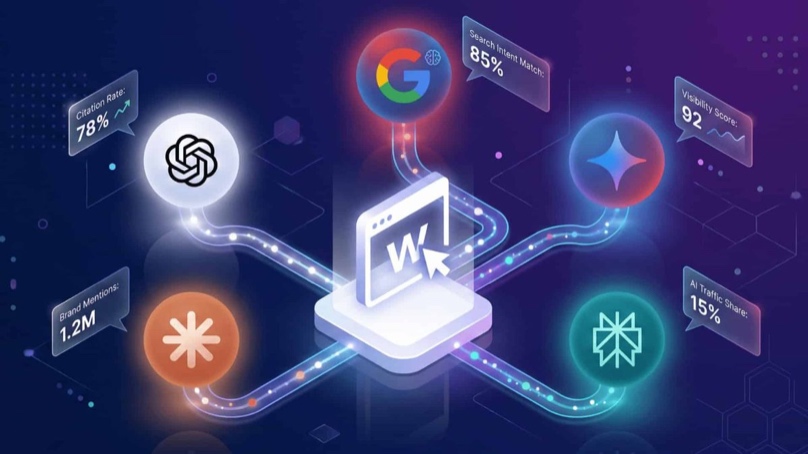
The category has matured quickly. The options below split into three clear groups: research-first consultancies that deliver a complete cross-LLM diagnostic in one engagement and then act on it, subscription monitoring dashboards built for ongoing tracking, and AI visibility features added to existing SEO toolsets. For a wider head-to-head buyer's comparison of AI visibility platforms, see the dedicated tool guide.
Disclosure: SwingIntel publishes this guide and appears in the table below. Read our own entry as a description of how we work, not as an independent verdict on it.
| Provider | Platform coverage | Pricing | Model | Best for |
|---|---|---|---|---|
| SwingIntel | 9 AI platforms + AI Overview + neural & agent search | Scoped in conversation | Consultancy: research, then hands-on repair | Comprehensive cross-LLM baseline, competitive benchmarking, and the fixes carried out |
| Otterly.ai | ChatGPT, Perplexity, Google AI Overview + more | From $29/month | Subscription monitoring | Simple ongoing tracking with a Brand Visibility Index |
| Peec AI | 8+ AI engines | From €89/month | Daily monitoring dashboard | European teams needing daily competitive intelligence |
| Profound | Major LLMs, 400M+ prompt dataset | From $499/month | Enterprise share-of-voice | Regulated industries needing SOC 2 / HIPAA-grade analytics |
| Scrunch AI | Multi-LLM real-time tracking | $300–$1,200/month | Persona journey mapping | Enterprise teams mapping AI-driven buyer journeys |
| Brandwatch | AI search layer on top of social listening | Enterprise pricing | Social + AI unified | Teams already on Brandwatch for social listening |
| Semrush AI Visibility Toolkit | ChatGPT + additional platforms | $99/month (Enterprise AIO on request) | SEO suite add-on | Existing Semrush users adding AI tracking |
| SE Ranking AI Tracker | Major AI platforms | SEO suite pricing | SEO suite add-on | Teams wanting a Brand Visibility Index inside their SEO toolkit |
| Ahrefs Brand Radar | AI + web brand mentions | Ahrefs subscription | SEO suite add-on | Ahrefs customers tracking AI alongside backlinks |
| Keyword.com | ChatGPT, Perplexity, Gemini, Claude, DeepSeek, Google AI Overviews | From $24.50/month (AI add-on) | Rank tracker + AI add-on | Budget-conscious teams bolting AI onto rank tracking |
SwingIntel is the one entry here that is not a tool at all. It is a consultancy taking a research-first approach, and the breadth of that first pass is the point: a single AI visibility research engagement runs 24 checks across structured data, content clarity, and technical signals, then queries 9 AI platforms (ChatGPT, Perplexity, Gemini, Claude, Google AI, Grok, Microsoft Copilot, DeepSeek, and Meta AI) with 108 structured citation prompts per market across 12 intent categories. On top of that it runs LLM Mentions analysis, Google AI Overview testing, neural search discoverability via Exa, and AI agent search visibility via Tavily. The output is a strategic document with an AI Readiness Score, automatic competitive benchmarking against the rivals AI platforms associate with your brand, and specific fixes and SwingIntel then implements those fixes, month after month where a business wants its visibility held up as the models keep moving. Every engagement includes a Global AI visibility baseline plus up to 3 target markets.
Otterly.ai offers the most accessible entry point for ongoing monitoring. Its Brand Visibility Index condenses cross-platform presence into a single number that marketing teams can track over time without interpreting complex dashboards. It's stronger on recurring tracking than initial audit depth, making it a good fit after baseline optimization.
Peec AI is built for teams that need daily tracking. Founded in 2025, it monitors brand visibility and sentiment across 8+ AI engines with automated checks, and its competitive share-of-voice dashboard is a standout, quantifying not just whether your brand appears, but how prominently compared to each competitor on each platform. GDPR compliance is built in, which matters for European operators.
Profound serves the enterprise end of the market with SOC 2 Type II compliance, HIPAA readiness, and a Citation Provenance Engine that identifies exactly which source URLs AI models pull from when they mention your brand. Access to over 400 million prompt insights gives the largest dataset for share-of-voice analysis at scale.
Scrunch AI maps how AI guides users through discovery stages (awareness through purchase decision) based on your brand's representation. Persona-based journey mapping and a Knowledge Hub that flags factual inaccuracies in AI's representation of your business suit enterprise marketing teams that want to understand how AI shapes the buyer journey around their category.
Brandwatch has bolted AI search monitoring onto its enterprise social listening suite. For teams already using Brandwatch for social and PR monitoring, consolidating the AI visibility layer reduces tool fragmentation, though the AI-specific capabilities are less specialized than dedicated platforms.
Semrush's AI Visibility Toolkit brings LLM tracking into the platform where many teams already manage keyword rankings, site audits, and competitive analysis. The integration matters because the signals that drive AI visibility (content authority, structured data, entity clarity) overlap significantly with organic ranking signals. Enterprise AIO adds large-scale prompt tracking across major LLMs and multi-brand reporting.
SE Ranking AI Tracker follows the same playbook: a Brand Visibility Index integrated into its SEO toolkit, alongside competitive benchmarking and keyword tracking. It's a pragmatic choice for teams who want AI visibility in the same place they already manage SERPs.
Ahrefs Brand Radar layers AI and web brand mention tracking on top of Ahrefs' existing backlink and keyword infrastructure. If you are already a heavy Ahrefs user, it is the path of least resistance into AI visibility.
Keyword.com has expanded beyond traditional SERP tracking to include LLM-specific monitoring across ChatGPT, Perplexity, Gemini, Claude, DeepSeek, and Google AI Overviews, tracking which keywords trigger AI citations and what sentiment those citations carry. URL-level attribution down to the specific LLM and prompt makes it granular, and the $24.50/month AI Visibility add-on is among the cheapest serious entry points in the market. The trade-off is depth, as the AI features sit on top of a rank tracker rather than an AI-native architecture.
Choosing the Right Tool

Not all AI visibility tools measure the same things with the same accuracy. When comparing options, four criteria separate useful from superficial.
Platform breadth. Does the tool test across all the major AI platforms, or just one or two? Citation rates vary significantly between platforms. Single-platform tools produce an incomplete picture of where your brand actually stands.
Audit depth. Surface-level audits miss the technical and structural issues that drive citation failures in the first place. Look for tools that examine structured data implementation, entity recognition, content authority signals, and page-level technical factors together, not just prompt-response logging. Dedicated citation analysis tools sit alongside broader visibility platforms when source-level diagnosis is the priority.
Actionable output. Citation data is useful only if the tool translates it into specific improvements: which pages need structured data, which content gaps create citation failures, which competitor signals to address. A score without a fix list creates awareness but not progress.
Baseline and tracking. AI visibility changes as you optimize and as platforms retrain. Tools that provide a clear starting baseline and track improvement over time are more valuable than one-time snapshots with no continuity.
The most effective sequence is audit first, then monitor. Subscribing to daily monitoring before establishing a baseline is like checking a stock price hourly without knowing what you paid for it: motion without meaning. An audit gives you the cross-platform picture and the prioritized fix list. A monitoring tool then confirms whether those fixes are moving the numbers.
An Effective Monitoring Workflow

The most effective approach combines automated monitoring with periodic deep audits. Four components make the workflow scale.
Baseline audit. Run a comprehensive scan covering citation testing, AI Overview presence, content structure, and competitive positioning across all major platforms. This is the foundation; everything else references it.
Highest-value query identification. List the 10 to 20 questions your ideal customers are most likely to ask an AI agent. Include product comparisons, "best of" queries, and specific problem-solving questions relevant to your industry. Rotate categories monthly (branded, category-level, competitor comparison, and problem-aware) to get broader coverage without running hundreds of queries per session.
Monthly testing, minimum. Run citation tests against your priority queries at least monthly. AI models update their knowledge bases and retrieval systems regularly, so visibility shifts between measurement periods. Monthly consistency separates meaningful change from random variation.
Data-driven action with change logging. Monitoring without action is expensive observation. When you identify gaps (a competitor cited where you are not, negative sentiment on a specific topic, missing structured data), prioritize fixes based on business impact. Log every website change alongside your monitoring results, and pair this with a structured brand-mention tracking workflow so off-site signals stay synchronized with on-site changes. If you added FAQ schema on March 1 and your Perplexity citation rate moved from 20% to 45% in April, that correlation is actionable intelligence you can repeat across other pages. For platform-specific tactics, our AI search visibility playbook for marketers breaks down what to prioritize per engine.

Common Monitoring Mistakes
Most businesses make the same errors when they first start. Each one skews results in a way that makes optimization guesswork.
Testing only branded queries. Asking whether AI mentions your company when you search for your company name tells you nothing useful. AI agents naturally surface your brand on branded queries. The valuable test is whether you appear when the query is generic, category-level, and competitive.
Inconsistent cadence. Running a test once, waiting three months, then comparing results produces noise rather than signal. AI platform behavior shifts as models are retrained. Monthly consistency (same query set, same platforms, same methodology) is the minimum viable rhythm.
Treating all platforms as equivalent. Each AI platform has a distinct retrieval architecture. Monitoring results should drive platform-specific decisions, not a one-size-fits-all approach applied identically across all nine engines.
Check-once-and-forget. A single snapshot tells you where you stand today; it says nothing about whether you are improving. The monitoring loop (test, change, retest, learn) is the point. Without the loop, you have a report, not intelligence.
Single-platform tracking. Covered above but worth repeating: the brand that ChatGPT recommends may be invisible on Perplexity. Any tool or workflow that only tests one engine is generating a systematically misleading picture.
No competitive benchmarking. Your citation rate means nothing in isolation. The question is whether you are being cited more or less than your competitors for the same queries. For a structured approach to this, see our guide to comparing AI visibility against competitors.
The Strategic Cost of Invisibility

AI visibility monitoring is not a nice-to-have, and it is not a one-time exercise. Every day your brand is absent from an AI answer is a day a buyer goes to a competitor without ever clicking a link you could optimize. Monitoring on its own is incomplete: once you see the gaps, the work shifts to actively winning the on-page mentions and source pickups that the tools track. As AI search captures a growing share of how people discover products and services, the businesses that track and fix their visibility now will compound an advantage that becomes harder to close over time.
The starting point is knowing where you stand. Request SwingIntel's AI visibility research — it tests your brand across 9 AI platforms with 108 structured citation prompts per market, delivering a cross-platform baseline, automatic competitive benchmarking, and a prioritized action plan. From there the same engagement closes the gaps it found, and keeps them closed as the models move.