Marketing survived search engines. It survived social media. It survived mobile. Each wave changed the channels, redistributed the budgets, reshuffled who won but the discipline itself survived intact because the audience was always human.
AI agents break that assumption. For the first time, the entity evaluating your brand, comparing your product and making the purchase decision is not a person. It is an algorithm that cannot be impressed by your creative, does not feel urgency from your countdown timer, and will never impulse-buy because your landing page hit the right emotional note.
That is not a channel shift. It is a structural rewrite of how discovery, evaluation and customer experience work and the brands that understand the rewrite are already building compounding advantages over the ones that don't. This guide walks the full picture in one place: what an AI agent actually is, the five architectures you need to know, ten production deployments delivering measurable ROI right now, how Google's and Anthropic's agent platforms are dismantling the traditional funnel, and what every business needs to do to remain visible when the buyer is a machine.
Key Takeaways
- Gartner predicts agentic AI will autonomously resolve 80% of common customer service issues by 2029, driving a 30% reduction in operational costs.
- 70% of consumers welcome AI agents helping them shop and 60% expect to use agentic AI for purchases within 12 months a new buyer that is immune to traditional marketing tactics.
- Only 23% of organizations are scaling agentic AI while 62% remain in experimental phases the readiness gap that will separate winners from casualties over the next 18 months.
- Production deployments from Klarna, Google DeepMind, John Deere, Darktrace, Siemens, Salesforce, Amazon, Spotify and others are already delivering measurable ROI not prototypes, not demos.
- Agent-driven discovery replaces impressions with citations, funnels with single prompts, and share of voice with Share of Model how often AI agents recommend your brand when consumers delegate decisions.
- The brands that win the agentic era deploy AI agents internally for operational leverage and ensure they are visible, citable and recommendable to the agents operating externally on behalf of their customers.
What Makes an AI Agent Truly Autonomous

The phrase "AI agent" has been stretched to cover everything from glorified chatbots to genuinely autonomous systems that plan, reason and execute multi-step tasks without human intervention. Cutting through that noise matters, because the businesses deploying real autonomous agents are already seeing measurable results while those still experimenting with basic automation are falling behind.
An AI agent is a system that perceives its environment, sets goals, plans actions, executes those actions and learns from outcomes all with some degree of autonomy. The key distinction is the decision loop. Agents do not simply execute instructions. They evaluate situations and choose responses. Every AI agent, regardless of type, operates through a perceive-decide-act cycle. What changes across types is the sophistication of each step: how much context the agent considers, how far ahead it plans, and whether it improves over time.
Consider the difference in customer service. A traditional chatbot handles "Where is my order?" by looking up a tracking number and returning it. An autonomous agent receives the same question, checks the tracking status, notices the package is delayed, identifies the cause (warehouse backlog versus carrier issue), determines the appropriate resolution (reship, refund, or credit), executes that resolution, updates the customer, and logs the interaction for future pattern analysis. One answers questions. The other solves problems.
Google Cloud's definition frames it cleanly: AI agents are autonomous systems capable of reasoning, planning and executing tasks independently. But autonomy exists on a spectrum, and understanding where each agent sits on that spectrum is the first decision that separates successful deployments from expensive failures.
The Five Core Types of AI Agents

According to PwC research, 79% of organizations have already adopted AI agents in some capacity and 66% of those have measured real productivity gains. But adoption and understanding are different things. Most businesses deploying agents could not explain the differences between the types they are using or whether they chose the right architecture for the job. Selecting the wrong one leads to predictable failures: over-engineered solutions for simple problems, brittle systems that cannot adapt, or autonomous agents deployed where deterministic rules would be safer and cheaper.
1. Simple Reflex Agents
Simple reflex agents are the most basic type. They operate on direct condition-action rules no memory of past interactions, no model of the world. If condition X is true, take action Y. That is the entire decision-making process.
How they work: the agent perceives the current state of its environment and maps it directly to a predefined action. No reasoning, no planning, no learning. The response is immediate and deterministic.
When to use them: monitoring and alerting systems where speed matters more than nuance; spam filters that classify messages by keyword patterns; thermostat-style controls that trigger actions at defined thresholds; invoice matching where rules are clear and exceptions are rare.
Strengths: fast, predictable, easy to test, cheap to operate, and transparent in their decision-making.
Limitations: they fail in any environment where the current observation does not contain enough information to make a good decision. They cannot handle ambiguity, partial information, or situations they have not been explicitly programmed to recognize.
Business reality: despite the hype around advanced AI, simple reflex agents remain the right choice for the majority of business automation tasks. If your problem can be expressed as a set of clear rules, using anything more complex adds cost and risk without adding value.
2. Model-Based Reflex Agents
Model-based reflex agents extend simple reflex agents by maintaining an internal representation of the world. They track state over time, which means they can handle situations where the current observation alone is insufficient.
How they work: the agent maintains an internal model that gets updated with each new observation. Decisions are still rule-based, but the rules can reference the agent's understanding of the broader environment not just what it sees right now.
When to use them: robotics and navigation where the agent needs to remember what it has already seen; long-running software workflows that track progress across multiple steps; inventory management systems that account for in-transit stock and pending orders; customer service bots that need conversation history to provide coherent responses.
Strengths: handle partially observable environments where the current state does not tell the full story. More robust than simple reflex agents without the overhead of full planning.
Limitations: the internal model can become stale or inaccurate. The agent still operates on predefined rules it does not plan ahead or reason about goals.
3. Goal-Based Agents
Goal-based agents introduce planning. Rather than reacting to the current state, they represent desired outcomes and work backwards to determine action sequences that achieve those outcomes.
How they work: the agent is given a goal state. It evaluates its current state, considers available actions, and plans a sequence of steps to reach the goal. This requires search and planning algorithms the agent is reasoning about the future, not just responding to the present.
When to use them: task scheduling and project management where multiple steps must be sequenced; route planning and logistics optimization; automated code generation where the agent plans structure before writing; agentic commerce systems where AI agents navigate multi-step purchasing workflows.
Strengths: can solve complex, multi-step problems. Flexible changing the goal changes behavior without rewriting rules.
Limitations: require clear goal definitions. Planning is computationally expensive. Performance degrades as the action space grows.
Enterprise impact: goal-based agents are the backbone of the agentic AI shift in marketing and operations. When an AI shopping assistant compares products, evaluates reviews and completes a purchase, it is operating as a goal-based agent with the goal of finding the best match for the user's requirements.
4. Utility-Based Agents
Utility-based agents go beyond goals. Where a goal-based agent asks "does this action achieve the goal?", a utility-based agent asks "how well does this action achieve the goal compared to alternatives?"
How they work: the agent assigns numerical utility scores to different outcomes and selects the action with the highest expected utility. This enables trade-off reasoning the agent can balance competing objectives like cost versus speed, quality versus quantity, or risk versus reward.
When to use them: recommendation engines that balance relevance, diversity and business objectives; resource allocation across competing priorities; dynamic pricing systems that optimize revenue against customer retention; portfolio management where risk and return must be balanced continuously; AI search engines deciding which brands to cite in their responses they are effectively running utility calculations across authority, relevance and recency.
Strengths: make trade-offs explicit and transparent. Handle multi-objective optimization naturally.
Limitations: defining the utility function is the hard part. A poorly designed utility function leads to optimizing for the wrong thing a problem that scales dangerously with agent autonomy.
5. Learning Agents
Learning agents improve their behavior over time by incorporating feedback from their environment. They do not rely solely on predefined rules or fixed utility functions they discover what works through experience.
How they work: a learning agent has four components a performance element (the current decision-maker), a critic (evaluates outcomes against a standard), a learning element (modifies the performance element based on feedback), and a problem generator (suggests exploratory actions to discover new strategies).
When to use them: personalization engines that adapt to individual user behavior; fraud detection systems where adversaries constantly change tactics; AI search systems that learn which content to recommend based on citation patterns and user engagement; autonomous vehicles navigating environments too complex for static rules; content recommendation algorithms that refine suggestions based on interaction data.
Strengths: handle environments that are too complex or dynamic for fixed rules. Continuously improve. Can discover strategies human programmers would not have designed.
Limitations: require significant training data and compute. Behavior can be unpredictable. Harder to audit, debug and explain. The learning process itself needs oversight to prevent drift toward undesirable behavior.
Hybrid and Multi-Agent Systems
The five types are conceptual categories, not rigid boundaries. The most effective production systems combine multiple approaches.
Hybrid agents layer different capabilities: reflexes for safety-critical fast responses, planning for complex tasks, and selective learning for adaptation. A self-driving car uses reflex rules for emergency braking (no planning needed just stop), goal-based planning for route navigation, and learning for adapting to driver preferences. In business, an AI customer service system might use simple reflex rules for routing, model-based tracking for conversation context, goal-based planning for issue resolution, and learning to improve responses over time.
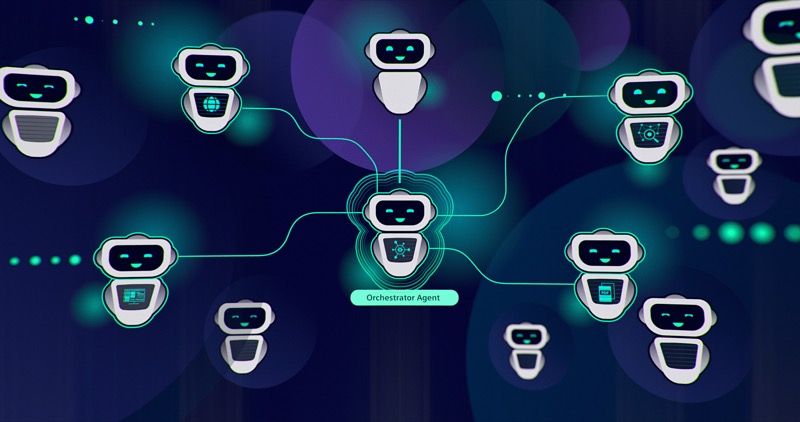
Multi-agent systems distribute decision-making across multiple cooperating agents. Gartner reported a 1,445% surge in multi-agent system inquiries from Q1 2024 to Q2 2025. The appeal is modularity: instead of building one agent that does everything, you build specialized agents that collaborate. A procurement system might have separate agents for vendor evaluation, price negotiation, compliance checking and order management each using the architecture best suited to its task.
How to Choose the Right Agent Type
The decision framework is straightforward once you strip away the hype.
Start with the problem, not the technology. What decisions need to be made? How much context is required? How dynamic is the environment?
Match complexity to necessity. If your problem can be solved with IF-THEN rules, use a simple reflex agent. Most businesses would benefit from more reflex agents and fewer learning agents not the other way around.
Consider observability. If the agent can see everything it needs in the current state, simpler agents work. If it needs memory (past states) or foresight (future states), move up the complexity ladder.
Evaluate the cost of errors. In safety-critical domains, deterministic reflex agents are preferable because their behavior is fully predictable. Learning agents should be reserved for environments where occasional suboptimal decisions are acceptable.
Plan for monitoring. As agent autonomy increases, so does the need for observability. If you cannot invest in monitoring infrastructure, simpler agent types are the safer choice.
10 Real-World AI Agent Deployments Actually Changing Business in 2026

The gap between AI agent hype and AI agent reality has never been wider. Every enterprise vendor claims their product is "agentic." Every conference keynote promises autonomous systems that will transform your business. And yet, most organizations experimenting with AI agents are still running glorified chatbots behind an "agent" label.
Buried underneath the marketing noise, though, something genuinely significant is happening. A handful of companies have moved past experimentation and deployed AI agents that operate autonomously, make real decisions and produce measurable business outcomes. The examples below span the full agent spectrum from deterministic rule-following systems to agents that genuinely learn and adapt.
1. Klarna Customer Service at Inhuman Scale
Klarna's AI assistant is the most cited example of production AI agents for good reason: the numbers are extraordinary. In its first month of full deployment, the system handled 2.3 million customer conversations equivalent to the workload of approximately 700 full-time customer support agents.
The agent does not just answer questions. It processes refunds, updates order details, checks delivery statuses, handles payment disputes and resolves account issues all without human escalation for the majority of interactions. Klarna reported that average resolution time dropped from 11 minutes with human agents to under 2 minutes with the AI system.
What makes this a genuine agent deployment is the decision-making loop. The system evaluates customer intent, accesses multiple backend systems (payments, logistics, account management), determines the appropriate action, executes it, and verifies the outcome. When it encounters edge cases outside its confidence threshold, it escalates to human agents with full context the human picks up mid-conversation, not from scratch.
Klarna also reported a 25% reduction in repeat customer inquiries, suggesting the AI agent resolves issues more completely than the average human interaction.
2. Google DeepMind Cooling Data Centers with Reinforcement Learning
Google's data centers consume enormous amounts of energy, and a significant portion of that goes to cooling. DeepMind deployed an AI agent to optimize cooling systems across Google's data center fleet. The result: a 40% reduction in cooling energy consumption.
The agent uses reinforcement learning it observes hundreds of sensor readings (temperature, power, pump speeds, setpoints), adjusts cooling parameters, measures the energy impact and refines its approach continuously. It operates in five-minute decision cycles, making thousands of micro-adjustments daily that no human operator could replicate at that speed or consistency.
What distinguishes this from simple automation is adaptability. The agent does not follow predetermined rules. It discovers optimal strategies human engineers had not considered sometimes producing counterintuitive configurations that reduce energy use while maintaining safe operating temperatures. The cumulative savings run into hundreds of millions of dollars annually.
3. John Deere See & Spray Precision Agriculture at Scale
John Deere's See & Spray technology represents one of the most physically impactful AI agent deployments in production today. The system uses computer vision and agentic decision-making to distinguish crops from weeds in real time, selectively applying herbicide only where weeds are detected.
The results: in 2025, John Deere customers ran See & Spray across more than 5 million acres and reduced non-residual herbicide use by an average of nearly 50%, saving more than 31 million gallons of herbicide mix in a single growing season. At scale, that volume of chemicals is not entering soil and groundwater systems a genuine environmental impact driven by autonomous AI decision-making.
The agent operates on a continuous perception-action loop. Cameras mounted on the spray rig capture images at high speed. A computer vision model classifies each plant as crop or weed in milliseconds. The agent decides whether to activate the spray nozzle for each individual plant. This happens thousands of times per minute as the equipment moves across the field. The learning component lets it improve classification accuracy over time as it encounters new plant varieties, growth stages and field conditions.
4. Darktrace Autonomous Cybersecurity Response

Darktrace's Cyber AI Analyst represents a fundamentally different approach to cybersecurity: an AI agent that does not just detect threats but autonomously responds to them. The system learns the normal pattern of digital life for every user and device in a network, then identifies and interrupts anomalous behavior in real time.
Traditional security tools rely on signatures known patterns of known attacks. Darktrace operates on deviation detection. It builds a behavioral model of what "normal" looks like for each network entity and flags when behavior diverges. A user logging in from an unusual location at an unusual time accessing files they have never touched before triggers investigation without any predefined rule matching that specific pattern.
The autonomous response capability is what elevates this beyond monitoring. When the agent identifies a high-confidence threat, it isolates affected devices, blocks suspicious connections and restricts user permissions all without waiting for a human analyst. Modern ransomware can encrypt an entire network in minutes; Darktrace's agent operates in the gap between detection and human response, buying time that often makes the difference between a contained incident and a catastrophic breach.
5. Siemens Industrial Copilot Manufacturing Intelligence
Siemens deployed its Industrial Copilot as an AI agent embedded directly into manufacturing operations. The system assists engineers with troubleshooting equipment failures, optimizing production line configurations and generating automation code all within the operational context of specific factory environments.
What separates this from a general-purpose AI assistant is integration depth. The Industrial Copilot connects to Siemens' industrial automation systems (PLCs, SCADA, MES), accesses real-time machine data, understands the specific configuration of each production line and generates recommendations grounded in actual operational parameters rather than generic best practices.
It does not suggest "check the motor" it identifies that motor 3B on line 7 is showing vibration patterns consistent with bearing wear based on the last 72 hours of sensor telemetry and recommends scheduling replacement during the next planned maintenance window.
6. Salesforce Agentforce Autonomous CRM Operations
Salesforce's Agentforce platform represents the largest-scale enterprise deployment of AI agents in the CRM space. The system goes beyond traditional lead-scoring automation, operating as an autonomous agent that manages sales pipeline activities without constant human direction.
The agent monitors behavioral signals website visits, email engagement, content downloads, meeting attendance, job title changes, company funding events and scores leads in real time. When a lead crosses a confidence threshold, the agent does not just flag it. It drafts personalized outreach, schedules follow-up sequences, updates CRM records and allocates the lead to the most appropriate sales rep based on territory, specialization and current workload.
Post-sale, it monitors customer health scores, identifies churn risk signals, triggers retention campaigns and routes expansion opportunities to account managers. The agent operates across the full customer lifecycle.
7. Forethought Resolving Support Tickets Before Human Contact
Forethought's AI agent takes a different approach from Klarna's. Rather than handling live conversations, Forethought's system intercepts support tickets before they reach a human queue, resolves them autonomously, and only routes to human agents when the issue exceeds the system's confidence threshold.
The agent reads incoming tickets, classifies the issue, searches internal knowledge bases for relevant solutions and generates a personalized response that accounts for the customer's product version, account type and interaction history. Forethought reports the system deflects up to 70% of routine support requests before they reach a human agent. The remaining 30% arrive with full context the AI's analysis, sources it consulted, confidence level and a suggested resolution so human agents spend less time on diagnosis and more on resolution.
8. Amazon Agentic Code Modernization at Enterprise Scale
Amazon's deployment of AI agents for code modernization is one of the most ambitious internal AI agent projects documented publicly. Using Amazon Q Developer, the company coordinated AI agents that modernized thousands of legacy Java applications, migrating them from older frameworks to current standards.
AWS reported that the agent-driven modernization effort saved an estimated 4,500 developer-years of manual work. That number represents not just time savings but a fundamental shift in how large organizations approach technical debt tasks previously deferred indefinitely are now feasible because agents can handle the volume. Generated code is validated against test suites, and flagged cases requiring human review are routed to engineers with full context.
9. Spotify Personalized Audio Experience at Consumer Scale
Spotify's AI DJ has shaped the listening experience for over 90 million Premium users since its 2023 launch, delivering personalized curation that goes beyond traditional recommendation. It analyzes listening history, real-time engagement (skips, repeats, saves, playlist additions), time-of-day patterns and contextual signals to curate a continuous, personalized audio stream adjusting in real time based on how the listener responds to each track.
What makes this agentic is the decision-making loop. Traditional recommendation systems generate a ranked list and serve it. Spotify's AI DJ operates continuously: if you skip three upbeat songs in a row, the agent recalibrates; if you add a track to a playlist, the agent infers a preference signal and adjusts the upcoming queue. The voice commentary layer explaining why it selected certain tracks demonstrates an agent that does not just make decisions but communicates its reasoning.
10. Compliance Automation The Quiet Revolution
The compliance space is the least glamorous but most consequential area of AI agent deployment. Companies like Norm.ai and Sprinto have deployed agents that monitor regulatory requirements, audit operational processes, identify compliance gaps and generate remediation actions continuously and autonomously.
Traditional compliance is periodic: quarterly audits, annual reviews, manual checklists. AI compliance agents operate continuously. They monitor regulation changes across jurisdictions, compare operational processes against updated requirements, flag gaps and in some cases automatically adjust workflows to maintain compliance. Banks and insurance companies operate under thousands of requirements across multiple jurisdictions manual monitoring produces gaps; AI agents flag violations in real time and maintain audit trails that satisfy regulatory scrutiny. Cognizant has built similar agents for legal contract review, compressing review timelines from weeks to hours.
The Pattern Behind Successful AI Agent Deployments
Across these examples, a consistent pattern emerges. The agents that deliver real results share four characteristics:
High-volume, repetitive decision-making. Every successful deployment targets workflows where the same type of decision is made thousands or millions of times. Consistency and speed create disproportionate value at that frequency.
Measurable feedback loops. Agents that improve over time operate in environments where outcomes are measurable. Did the customer contact support again? Did the cooling adjustment reduce energy use? Was the transaction fraudulent? Clear feedback enables learning and learning separates agents from automation.
Structured operating environments. None of these agents operate in completely unstructured contexts. They work within defined systems (CRM platforms, sensor networks, code repositories, network infrastructure) where inputs are structured and the action space is bounded. Not a limitation a design principle.
Human escalation paths. Every production deployment includes a mechanism for routing uncertain decisions to humans. Agents handle the volume; humans handle the edge cases. Organizations that insist on full autonomy with no human fallback do not ship to production.
The Customer Experience Transformation

The impact of autonomous agents on customer experience goes beyond faster response times. It changes the nature of the relationship between businesses and customers.
From Reactive to Anticipatory
Traditional customer experience is fundamentally reactive: something goes wrong, the customer contacts support, the business responds. Autonomous agents invert this model. By continuously monitoring customer data, product usage patterns and operational status, agents identify and resolve issues before customers experience them.
A SaaS company using agentic monitoring might detect that a customer's API usage is approaching their plan limit, predict they will hit the cap during a critical business period based on historical patterns, and proactively reach out with an upgrade offer or temporary capacity increase. The customer never experiences an outage. The business never loses the renewal.
When a logistics agent detects a delivery van breakdown, it can automatically reschedule affected deliveries, apply service credits to customer accounts and notify customers with updated time slots all before the customer knows there is a problem. This "concierge model" of service, grounded in real-time CRM and operational data, is replacing the model where customers must explain their problem to each new touchpoint.
Personalization at Scale

The promise of "personalized experience" has been a marketing cliche for a decade. Autonomous agents are finally making it operational. Companies like Sephora and Starbucks use agentic AI to analyze purchase history, browsing behavior and contextual preferences to deliver recommendations that adapt in real time not based on broad segments, but on individual patterns.
The difference is that autonomous agents do not just personalize content. They personalize entire journeys adjusting the sequence of interactions, the timing of outreach, the channel of communication and the specificity of offers based on what they learn about each individual customer.
Bounded Autonomy: The Trust Equation
Autonomy only works when AI is deeply grounded in context customer history, policy rules, operational limits, real-time conditions. Without that grounding, autonomous systems do not make confident decisions. They make confident mistakes.
The most successful deployments share a common architecture: agents have broad capability to act, but narrow authority defined by explicit guardrails. An agent might have the capability to issue refunds, but its authority is bounded by refund policy rules, customer lifetime value thresholds and fraud detection signals. This "capable but bounded" model is what makes autonomy safe enough to deploy at scale.
BCG research shows that agentic AI in operations is moving beyond pilots into production systems that handle procurement negotiations, vendor management and logistics coordination autonomously always within bounded authority. The competitive advantage is not just cost reduction. It is speed. Businesses that can respond to supply disruptions in minutes rather than days build structural resilience that compounds over time.
How Gemini, Stream Realtime and Claude Are Rewriting Marketing

Every major AI lab has stopped building chatbots and started building agents. Google, Anthropic and OpenAI are each shipping autonomous systems that research, evaluate and act on behalf of users often without ever surfacing a traditional search result. For marketers, this is not an incremental shift. It is a wholesale rewrite of how customers discover, evaluate and choose brands.
AI-driven advertising spend is growing rapidly, but the real disruption is not in ad spend it is in discovery. When a potential customer asks Gemini to research project management tools or tells Claude to find the best CRM for a 50-person sales team, those AI agents decide which brands get mentioned and which get ignored. Traditional marketing funnels assumed a human at every stage: a person types a query, scans results, clicks through to websites, compares options, makes a decision. AI agents compress this entire journey into a single interaction.
This changes the fundamental unit of marketing from impressions to AI citations. Getting mentioned in an AI agent's response is the new equivalent of ranking on page one except there is no page one. There is only the answer.
Gemini Deep Research: The End of Browse-and-Compare
Gemini Deep Research is Google's autonomous research agent. When activated, it does not return ten blue links. It conducts a multi-step investigation scanning dozens of websites in a single run and synthesizing findings into a structured report, complete with citations and source evaluation.
For marketers, this has three immediate consequences:
- Your content must be extractable, not just readable. Gemini pulls specific data points, statistics and structured claims. If your value proposition lives in a hero video or an interactive demo, the agent cannot parse it. Content needs structured headers, explicit claims and machine-readable formats.
- Third-party validation matters more than self-promotion. When Gemini cross-references multiple sources, independent reviews, industry reports and analyst mentions carry more weight than your own marketing copy.
- The customer discovery phase is collapsing. Gemini delivers a synthesized answer that often eliminates the need to visit individual websites. If your strategy depends on driving website traffic, you need to rethink how value reaches prospects who may never click through.
Google Stream Realtime: Context-Aware AI in the Moment
Stream Realtime is Google's less-discussed but potentially more disruptive AI agent feature. Unlike Deep Research, which operates asynchronously, Stream Realtime observes what a user is doing on-screen and provides contextual guidance in real time.
Imagine a marketing manager reviewing a competitor's pricing page. Stream Realtime can proactively surface comparisons, identify gaps in the competitor's offering and suggest alternatives without the user explicitly searching for anything. This creates an entirely new category of brand touchpoint: your content can surface in contexts you never planned for, triggered not by a search query but by a user's real-time activity.
Product pages must contain verifiable, structured comparison data agents can reference during real-time evaluation. Pricing transparency becomes a competitive advantage because agents actively compare pricing across brands in context. Technical documentation and API references become marketing assets, since agents surface them during evaluation workflows.
Anthropic Claude and MCP: The Autonomous Marketing Workflow
Claude's differentiation is not in search it is in action. Through the Model Context Protocol (MCP), Claude connects to external tools via secure APIs, enabling autonomous multi-step workflows that previously required human coordination.
The Trade Desk is already running a closed beta that allows advertisers to create programmatic campaigns using Claude. Claude analyzes audience data, generates creative variations, sets bid parameters and launches campaigns compressing what once took a media buying team days into minutes.
For brands, Claude's agentic capabilities create a dual challenge. As a discovery channel: Claude recommends brands during research and planning workflows. When a user asks Claude to build a go-to-market plan, the brands Claude mentions become the default shortlist. Your brand's presence in LLM training data and real-time retrieval directly determines whether you appear. As a workflow executor: Claude increasingly handles the tasks that follow discovery configuring tools, generating reports, managing campaigns. Brands with well-documented APIs, clear integration guides and structured product data become easier for Claude to work with, creating a compounding advantage.
What Dies in Traditional Marketing
Not everything in marketing is at risk. But several pillars the industry has treated as permanent are being undermined faster than most marketers realize.
The awareness funnel dies. The traditional funnel awareness, interest, consideration, intent, purchase assumes a human moving through stages where marketing can influence each transition. AI agents compress this into a single interaction. A consumer says "find me the best CRM for a 50-person sales team under $100/user" and the AI researches, compares and recommends in seconds. There is no awareness stage to win. No consideration phase to nurture. No intent signal to retarget. The entire buyer journey collapses into a prompt and an answer.
Brand advertising loses its leverage. When a human shops, brand familiarity creates a cognitive shortcut. AI agents have no such bias. They evaluate products on specifications, reviews, pricing and verifiable claims. A beautifully designed brand campaign that cost millions to produce has zero influence on whether ChatGPT recommends your product. The agent does not watch your TV spot, scroll past your Instagram ad or remember your billboard.
Retargeting becomes irrelevant. The entire retargeting ecosystem tracking pixels, cookie-based audiences, lookalike modeling assumes a human browser to follow around the internet. AI agents do not browse. They query, evaluate and decide. There is no session to retarget, no abandoned cart to email about, no browsing history to analyze. When AI agents handle the purchase, the surveillance-based advertising model loses its subject.
Content volume as a strategy collapses. Publishing hundreds of thin articles to capture long-tail keywords worked when humans clicked through search results. AI agents do not click through anything. They synthesize information from across the web and surface the sources that add genuine value. Content farms that rely on volume over substance become invisible to the very systems that now mediate discovery.
What Replaces It

The death of traditional marketing tactics does not mean the death of marketing itself. It means the discipline evolves and the brands that evolve fastest gain advantages that compound over time.
Machine readability replaces creative persuasion. When the buyer is an AI agent, the first requirement is that the agent can actually parse your information. Structured data, consistent product specifications, API-accessible catalogs and machine-readable content become the foundation of visibility. You cannot persuade an agent that cannot read your data.
Third-party authority replaces self-promotion. AI agents verify claims by cross-referencing independent sources. They weight expert reviews, industry publications and community discussions more heavily than anything on your own website. The brands winning AI citations are the ones with deep third-party footprints not the ones with the best "About Us" page.
Share of Model replaces share of voice. The emerging metric that matters is how often AI agents recommend your brand when consumers ask category-level questions. "What is the best project management tool?" "Which CRM works best for remote teams?" Your visibility in these AI-mediated conversations is the new market share and most businesses are not even measuring it yet. Gartner predicts that 60 percent of brands will use agentic AI for customer interactions by 2028.
Factual density replaces emotional storytelling. AI agents evaluate brands on data: specifications, pricing consistency, feature comparisons, independent validation. Content that AI systems can cite as authoritative buying guides with real data, comparison pages with verified specifications, research backed by methodology becomes the highest-value marketing asset. The story still matters for human audiences. But the agent needs facts.
Speed and structure replace campaign cycles. Traditional marketing operates in quarterly campaigns, monthly content calendars and weekly optimization cycles. AI agents operate in milliseconds. Brands with unified, accessible data stacks respond instantly. Brands with siloed legacy systems return nothing when an agent comes looking.
The Readiness Gap
The data on organizational readiness is stark. 62% of organizations remain in experimental phases with agentic AI. Only 23% are actively scaling. Meanwhile, 97% of companies expect conversational agents to be mainstream within two to three years.
That gap between expectation and preparation defines the competitive landscape for the next 18 months. The brands scaling now are building the data infrastructure, structured content and third-party authority that AI agents require. The brands still experimenting will find themselves invisible to a buying channel growing at 527% year-over-year.
This is not a technology problem. It is a strategic one. Most marketing teams are still optimizing for human attention in a world where an increasing share of purchase decisions are made by machines that never see their ads, never visit their landing pages and never feel their brand story.
What AI Agents Look For in Your Content

AI agents do not evaluate content the way humans do. They do not respond to emotional storytelling, clever headlines or visual design. They look for four things:
Verifiable claims with sources. Agents cross-reference data. A statement like "our platform increases conversion rates by 40 percent" is more likely to be cited if it links to a case study or independent research than if it appears as unsourced copy.
Structured, extractable information. Headers that clearly describe what follows, ordered lists of features or steps, comparison tables and FAQ sections all make content easier for agents to parse and cite. This is the foundation of AI search content optimization.
Entity clarity and consistency. Agents need to understand what your brand is, what it does and how it relates to other entities in your space. Consistent naming, clear schema markup and explicit entity relationships (via JSON-LD, Wikidata references and authoritative backlinks) improve comprehension.
Freshness and authority signals. Agents weight recent, well-sourced content higher. A blog post from 2023 with no updates will lose to a 2026 article covering the same topic with current data. Publishing cadence and content recency are measurable factors in AI discoverability.
Measuring Visibility in an Agent-Driven World
Traditional marketing metrics click-through rate, bounce rate, time on page measure human behavior on your website. When AI agents mediate discovery, you need different metrics:
Share of Model measures how often AI agents mention or recommend your brand relative to competitors the AI-era equivalent of share of voice.
AI citation rate tracks how frequently AI platforms cite your content when answering queries in your category. SwingIntel tests this across nine AI providers ChatGPT, Perplexity, Gemini, Claude, Google AI, Grok, Microsoft Copilot, DeepSeek and Meta AI to give brands a comprehensive view of their citation performance.
Agent discoverability score measures whether your content is technically accessible to AI agents: robots.txt configuration, sitemap presence, llms.txt implementation, structured data quality. These technical signals determine whether agents can even find your content before they evaluate it.
Neural search presence measures whether your brand appears when AI systems use semantic and vector search to find relevant entities a fundamentally different retrieval mechanism from keyword-based search.
What Separates Successful Deployments from Expensive Failures
Not every agentic AI deployment succeeds. The minority of organizations that have scaled beyond pilots share patterns the others can learn from.
Start with resolution, not conversation. The most common mistake is deploying an agent optimized for natural language interaction rather than problem resolution. Customers do not care how eloquent the agent sounds. They care whether their problem gets solved. Measure autonomous resolution rate, not conversation quality.
Ground agents in operational data, not just knowledge bases. An agent that can only reference FAQ articles is just a better search engine. Agents that connect to order management, CRM, logistics APIs and billing systems can actually resolve issues because they can see what happened and take action to fix it.
Design for human escalation, not human replacement. The future of customer experience is not AI versus humans. It is human judgment amplified by autonomous execution. The best systems make escalation seamless when an agent encounters a situation outside its authority, the handoff to a human includes full context so the customer never repeats themselves.
Measure what matters. The vanity metrics of chatbot deployments (deflection rate, sessions handled) are inadequate for agentic systems. The metrics that matter are autonomous resolution rate, customer effort score, time to resolution, and critically the rate at which agents make decisions humans later override. That last metric is your ground truth for whether autonomy is calibrated correctly.
Closing the Visibility Gap
Here is what most coverage of agentic AI misses: the same autonomous agents transforming internal operations are also transforming how customers discover and evaluate businesses externally.
When AI agents research products, evaluate services or recommend solutions on behalf of consumers, they do not browse the web the way humans do. They process structured data, evaluate authority signals, cross-reference sources and make recommendations based on patterns that are fundamentally different from traditional search ranking.
A business can have the best autonomous customer service agents in its industry and still be invisible to the AI agents driving customer acquisition. Internal AI capability and external AI visibility are two different problems and solving one does not automatically solve the other.
The businesses that will win the agentic era deploy autonomous agents internally for operational efficiency and ensure they are visible, citable and recommendable to the autonomous agents operating externally on behalf of potential customers.
What to Do Now
The transition is not a single project. It is a strategic shift that touches every function. But the starting points are clear:
- Audit your AI visibility. Do not guess whether AI agents can find and cite your brand. Test it across multiple platforms. The gap between brands that are visible to AI and those that are not is widening every month.
- Audit your customer service for autonomous resolution potential. Identify the high-volume, pattern-based issues agents can resolve without human intervention. Start there.
- Structure content for extraction. Every page that matters to your business should have clear headers, explicit claims, structured data markup and verifiable sources. Think of your content as a database agents query, not a narrative humans read.
- Ground your agents in operational systems. Connect them to the data sources where problems actually get solved not just the knowledge bases where answers are documented.
- Design for bounded autonomy. Give agents broad capability with narrow, explicit authority. Expand authority incrementally as confidence data accumulates.
- Build third-party authority. Invest in analyst coverage, industry reports, authoritative backlinks and review platform presence. A brand mentioned across multiple independent sources is dramatically more likely to be cited by agents.
- Measure what matters next. Move beyond traffic-centric metrics. Track AI citations, Share of Model, agent discoverability scores and neural search presence alongside traditional KPIs.
The agentic era is not approaching it is here. Target has seen 40% month-over-month growth in ChatGPT referral traffic. Some brands already attribute 10% of revenue to agentic channels. AI-referred sessions grew 527% in a single year. 60% of US shoppers say they expect to use AI agents for purchases within the next 12 months.
The question is not whether AI agents will reshape your market. They already are. The question is whether your brand is visible to them when it matters.
Frequently Asked Questions
What is an AI agent?
An AI agent is a software system that perceives its environment, makes autonomous decisions and takes actions to achieve specific goals without requiring human approval for each step. Unlike traditional software that follows predetermined rules, AI agents operate in perception-action loops they observe, decide, act, evaluate the outcome and adjust. Agents range from simple reflex systems to learning agents that improve over time.
What are the five core types of AI agents?
Simple reflex agents (direct condition-action rules), model-based reflex agents (reflex agents with an internal world model), goal-based agents (plan actions to reach a defined goal), utility-based agents (select actions by maximizing a utility score across competing objectives) and learning agents (improve their behavior from environmental feedback). Most production systems are hybrids that combine multiple types.
What are the best examples of AI agents in business?
The most proven AI agent deployments in 2026 include Klarna (handling 2.3 million customer conversations monthly), Google DeepMind (reducing data center cooling energy by 40%), John Deere See & Spray (cutting herbicide use by nearly 50% on average across 5 million acres in 2025), Darktrace (autonomous cybersecurity response), Siemens Industrial Copilot (manufacturing intelligence), Salesforce Agentforce (autonomous CRM operations) and Amazon Q Developer (modernizing thousands of legacy applications). Each demonstrates AI agents making consequential decisions at scale without human intervention for the majority of interactions.
How do AI agents affect brand visibility?
AI agents that make recommendations in search (ChatGPT, Perplexity, Gemini, Google AI Overview), sales (Salesforce Agentforce), customer service (Klarna, Forethought) evaluate brands based on the structured data, authority signals and consistent information available to them. Brands that are visible across AI discovery channels are more likely to be recommended by these systems. This creates a compounding effect: brands that get cited by AI agents build reference patterns that make future citations more likely.
Are AI agents replacing human workers?
Evidence from production deployments suggests augmentation rather than replacement. Every successful AI agent deployment includes human escalation paths agents handle high-volume routine decisions while humans handle edge cases, strategy and oversight. Klarna's AI handles 2.3 million conversations but routes complex issues to human agents. Amazon's code modernization agents flag uncertain decisions for engineering review. The pattern is consistent: AI agents increase human capacity rather than eliminating human roles.
What industries are using AI agents most effectively?
Customer support, cybersecurity, agriculture, manufacturing and financial compliance are the most advanced sectors for production AI agent deployment in 2026. These industries share characteristics that favor agentic AI: high-volume decision-making, measurable outcomes, structured operating environments and clear feedback loops. Healthcare and legal services are the next wave, with agents handling administrative workflows, document review and regulatory compliance monitoring.
How should I measure AI visibility for my brand?
Track four metrics alongside traditional KPIs: Share of Model (how often AI agents recommend your brand when users ask category questions), AI citation rate (how frequently AI platforms cite your content across providers), agent discoverability score (technical accessibility via robots.txt, sitemap, llms.txt and structured data) and neural search presence (whether your brand surfaces in semantic and vector search). Together they describe whether your brand exists in the world AI agents actually see.