Google Search is no longer ten blue links. Google AI Mode, a dedicated, conversational search experience powered by Gemini, now serves over one billion monthly active users and had already passed 75 million daily active users by late 2025. That makes it the biggest change to search since featured snippets, and the most consequential shift in brand visibility since the rise of AI Overviews.
If your website is not being cited in AI Mode, you are invisible to a fast-growing, high-intent segment of Google's user base. Traditional organic rankings no longer guarantee visibility: only 32% of URLs appearing in AI Mode overlap with Google's top 10 results, and only 13.7% of AI Mode citations overlap with AI Overviews citations. Winning in one does not carry over to the other.
This guide explains what AI Mode is, how query fan-out actually works, how it differs from AI Overviews, what the shift means for your brand, and the concrete steps that improve your chances of being cited.
Key Takeaways
- Google AI Mode processes over 1 billion monthly queries and has 75 million daily active users across 200+ countries. It uses Gemini to generate cited, conversational answers instead of blue links.
- AI Mode uses query fan-out (8 to 12 parallel sub-searches per query, sometimes hundreds for complex questions) and evaluates content at the passage level rather than the page level.
- Only 32% of URLs in AI Mode match the top 10 organic results, and only 13.7% of AI Mode citations overlap with AI Overviews citations. Ranking well in traditional search does not guarantee AI citation.
- 93% of AI Mode searches produce zero clicks. Brand visibility now means being named as a source in the AI-generated answer.
- Brands cited in Google's AI surfaces earn 35% more organic clicks and 91% more paid clicks than non-cited competitors (Seer Interactive), making citation the single most valuable form of visibility in this surface.
What Is Google AI Mode
Google AI Mode is a standalone, conversational search experience built on Gemini, Google's most capable AI model. Rather than returning a ranked list of web pages, it generates a single, comprehensive answer that synthesizes information from dozens of sources across the web, complete with inline citations.
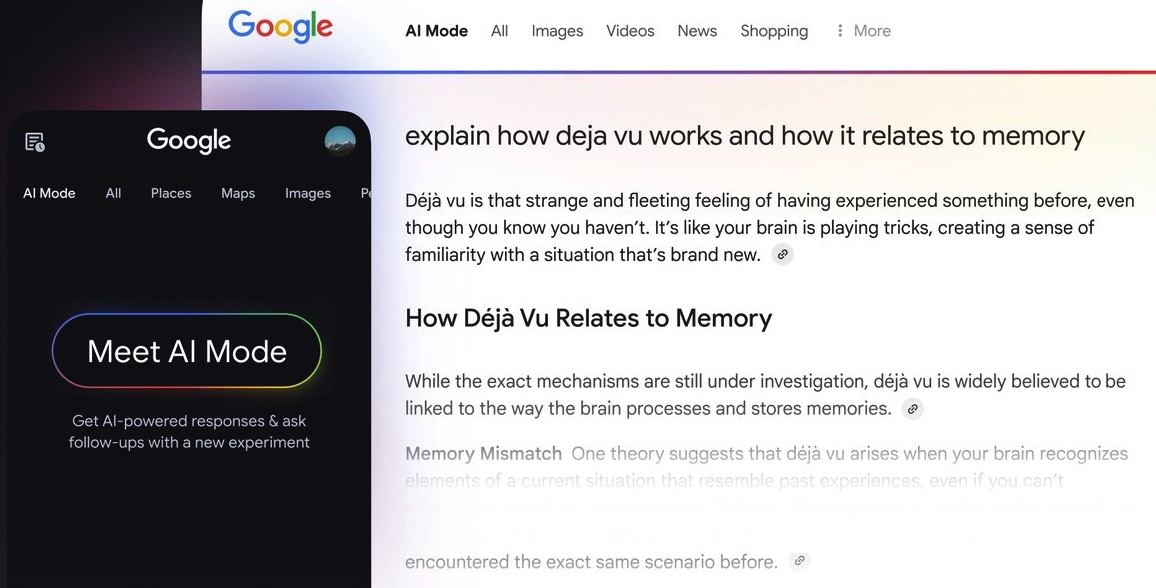
Think of it as Google's answer to ChatGPT, but grounded in real-time Google Search infrastructure and built directly into google.com. Users opt in by clicking the "AI Mode" tab at the top of Google Search. Once inside, they can ask complex, multi-part questions and continue the conversation with follow-up questions that carry context forward, something traditional search has never supported.
AI Mode also accepts multiple input methods. You can type a question, speak it aloud, upload a photo, or even point your phone's camera at something and ask about it. For deeper research tasks, the Deep Search feature investigates a topic across the web and returns a fully cited report in minutes, work that would take a human researcher hours.
The key distinction from traditional search: AI Mode is not automatic. Users actively choose it when they want deeper, more comprehensive answers than standard results provide. That self-selection means AI Mode users tend to arrive with higher-intent, more complex questions, which raises the stakes for brands competing to be cited.
How AI Mode Works: Query Fan-Out and Passage-Level Retrieval
The technology behind AI Mode is what makes it fundamentally different from any previous search experience. It uses a technique Google calls query fan-out.
When you submit a query in AI Mode, Google does not run a single search. Instead, Gemini breaks your question into subtopics and runs 8 to 12 parallel searches simultaneously, sometimes hundreds for complex queries. Each sub-query targets a different angle: definitions, comparisons, examples, expert opinions, counterarguments, and supporting data.
The results from all of those parallel searches are then synthesized by Gemini into a single, integrated response. The system has effectively done ten minutes of research in seconds, triangulating an answer from dozens of sources rather than surfacing the single top-ranked page for a keyword.
Critically, AI Mode uses passage-level retrieval. It evaluates specific sections of your content rather than the page as a whole. A single well-structured paragraph that directly answers a sub-query can earn a citation, even if the rest of the page is mediocre. Conversely, a generally strong page with vague, unfocused sections gets passed over in favor of a competitor whose page answers the specific sub-query more directly.
This passage-first architecture is why only 32% of URLs appearing in AI Mode match Google's top 10 organic results. The pages that rank well in traditional search are not necessarily the ones that get cited in AI Mode, because Gemini is not looking for the best page, it is looking for the best paragraph.
AI Mode vs AI Overviews: The Critical Differences
AI Overviews and AI Mode both use Gemini to generate answers, but they serve different purposes and behave very differently. Treating them as the same feature, or assuming optimization for one covers the other, is one of the most expensive mistakes brands are making in 2026.
AI Overviews appear automatically at the top of standard search results when Google determines an AI summary adds value. Users do not opt in; the summary simply appears above the organic listings for straightforward queries like definitions, quick comparisons, and factual lookups. AI Mode, by contrast, is a separate, opt-in experience that replaces the traditional results page entirely with a conversational interface.
The depth difference is significant. AI Overviews provide a brief summary with a handful of citations. AI Mode responses are 4x longer than AI Overviews on average and cite more sources per answer. Brands appear in approximately 90% of AI Mode responses, compared with just 43% in standard AI Overviews, making AI Mode a higher-opportunity surface for visibility.
The most consequential difference, though, is citation behavior. Ahrefs analyzed 730,000 response pairs and found that while AI Mode and AI Overviews reach similar conclusions (86% semantic similarity), they cite different sources. Only 13.7% of citations overlap. This means being cited in AI Overviews does not guarantee visibility in AI Mode, and vice versa. Brands need to optimize for both as distinct surfaces.
| Feature | AI Overviews | AI Mode |
|---|---|---|
| Activation | Automatic (Google decides) | User opts in via AI Mode tab |
| Format | Brief summary above search results | Full conversational interface |
| Follow-up questions | Not supported | Supported (context carries forward) |
| Response length | Short (1-2 paragraphs) | 4x longer on average |
| Brand appearance rate | ~43% | ~90% |
| Citation overlap with AI Mode | 13.7% | N/A |
| Input types | Text only | Text, voice, image, camera |
The practical implication: AI Mode offers more citation opportunities per answer, but the bar is higher because retrieval happens at the passage level, not the page level. A page that wins in AI Overviews on the strength of its opening paragraph may lose in AI Mode if its deeper sections are thin or unfocused.
Who Uses AI Mode and Where Is It Available
Google AI Mode reached 75 million daily active users as of late 2025, having expanded to over 180 new countries and territories on top of the US, UK and India. That makes it one of the most widely adopted AI search experiences globally, second only to Google's own AI Overviews in reach.
AI Mode launched in March 2025 as a Search Labs experiment for Google One AI Premium subscribers, then opened to all US users in May 2025 with no waitlist required, before rolling out globally from there. It is accessible via the Google Search app on Android and iOS, Chrome, and google.com on desktop. The United States and India together account for over 100 million monthly active users, a clear signal that AI Mode adoption is compounding quickly in Google's largest markets.
Three 2026 developments make AI Mode increasingly central to the search experience:
- Personal Intelligence (January 2026): AI Mode can now connect to Gmail and Google Photos, referencing personal emails, travel bookings, and transaction histories when generating answers. This makes responses even more contextual and reduces the need to visit external websites for personalized information.
- Ads expanding into AI surfaces: Ads now appear on 25.6% of AI Overview SERPs, up from 5.2% in March 2025, and Google is rolling the same monetization playbook into AI Mode, signaling commitment to making AI Mode a permanent, monetized surface rather than an experiment.
- Multimodal expansion: Camera and voice input are now first-class citizens in AI Mode, pushing it beyond text queries into the agentic, conversational territory that ChatGPT and Perplexity pioneered.
What AI Mode Means for Your Brand Visibility
The shift from keyword matching to passage-level synthesis changes the visibility equation in three important ways.
Traditional rankings are no longer enough. Ranking on page one does not guarantee citation in AI Mode. The system pulls from whichever source provides the clearest, most specific answer to each sub-query. A page ranked fifteenth in organic results can be cited in AI Mode if it contains the single best paragraph on a specific subtopic, and a page ranked first can be ignored if its prose is vague.
Breadth and depth both matter. Because AI Mode runs multiple sub-queries, it rewards content that covers a topic comprehensively. Thin, single-keyword pages get overlooked. But pure length is not the answer either; each section must independently answer a specific question with specific evidence. The sites winning in AI Mode are those that answer difficult questions clearly and prove what they know with data.
Citation is the new click. Here is the statistic that should reshape every brand's measurement model: 93% of AI Mode searches produce zero clicks to external websites. Users get their answer directly from the AI-generated response without ever visiting a source page. In traditional search, visibility meant ranking on page one. In AI Mode, visibility means being cited as a source. If you are not cited, you are invisible. There is no list of blue links to fall back on.
The upside for brands that do earn citations is substantial. Seer Interactive's analysis of Google's AI surfaces found that brands cited in AI answers earn 35% more organic clicks and 91% more paid clicks compared to non-cited competitors. Being named as a trusted source by Google's AI carries an authority signal that extends well beyond any single surface; it influences how users perceive the brand across the rest of search.
AI Mode also limits initial source visibility to just 1–3 citations displayed inline, with remaining sources hidden behind a "Show all" button. Competition for those top citation slots is fierce, and the brands winning them are those with clear, authoritative, well-structured content. The 69% click-through rate for transactional queries in AI Mode is promising for commercial content, but for informational queries, the click rate is far lower, which makes inline citation the highest-leverage goal.
If your brand is already struggling with AI Overviews reducing your organic traffic, AI Mode amplifies the same challenge. The businesses losing visibility are those that have not adapted their content strategy for AI-powered search.
How to Get Your Brand Cited in Google AI Mode
These are the practical steps that improve your chances of being cited in AI Mode responses. They build on generative engine optimization fundamentals but go further to address AI Mode's specific retrieval patterns.
Structure Content Around Questions
AI Mode breaks queries into question-based sub-queries. Structure your content to match. Use question-style H2 and H3 headings that mirror the questions your audience actually asks. Place the direct answer in the first one to three sentences after the heading, then follow with context, evidence, and examples.
This is not just good practice; it is directly aligned with how AI Mode's passage-level retrieval works. Each heading-and-answer pair becomes a self-contained unit that Gemini can evaluate and cite independently.
Make Every Section Self-Sufficient
Because AI Mode evaluates passages rather than pages, every section of your content must stand on its own. A reader (or an AI model) should be able to understand the answer from that section alone, without needing to read the entire page for context.
Include specific data points, named sources, and concrete examples within each section. Sections that say "as mentioned above" or rely on context from earlier paragraphs are less likely to be extracted and cited. Think of each section as a potential standalone answer to a question someone might ask in isolation.
Lead With Facts, Not Fluff
AI Mode prioritizes sources that provide specific, verifiable information. A statement like "we run 108 structured prompts across 9 AI platforms" is citable. A statement like "we offer comprehensive testing" is not. Data, numbers, named entities, and concrete claims win citations. Generic marketing language gets passed over for the competitor who wrote a sharper sentence.
Implement Comprehensive Structured Data
Structured data helps AI agents understand what your content is about before they read it. Implement JSON-LD schema markup (Organization, Article, FAQ, HowTo, and Product schemas) to give Gemini machine-readable context about your pages.
FAQ schema is particularly effective for AI Mode because it mirrors the question-and-answer format that the system is designed to retrieve. Each FAQ entry becomes a potential citation target for a matching sub-query.
Build Topical Authority, Not Just Individual Pages
AI Mode's query fan-out evaluates your site across multiple sub-queries simultaneously. Sites that cover a topic comprehensively across multiple interlinked pages signal authority more strongly than a single long-form page trying to cover everything alone.
Build topic clusters: a pillar page that provides the broad overview, supported by detailed pages that go deep on each subtopic. Link them together with clear, descriptive anchor text. This architecture gives AI Mode multiple citation targets across related queries, and the internal link structure helps Gemini understand the relationships between your content.
Strengthen E-E-A-T Signals
Google selects AI Mode sources based on Experience, Expertise, Authoritativeness, and Trust signals. Content that demonstrates genuine expertise (original research, first-hand experience, proprietary data, named authors with credentials) gets cited over generic aggregation.
Earn mentions from authoritative domains to build entity authority across the web. Add genuine expert contributions to Wikipedia, industry publications, and professional communities. Unlinked brand mentions from high-authority sites carry weight in the trust calculation, so off-site presence matters as much as on-site signals.
Keep Content Fresh and Dated
AI Mode prioritizes recent information. Pages with visible, accurate publish dates and regular updates signal to Gemini that the content reflects current knowledge. Outdated content, especially on fast-moving topics, gets deprioritized in favor of fresher sources.
Review and update your key content quarterly. When you update, change the publish date and note what was updated. This is not just good practice for users; it is a signal that AI Mode's retrieval system uses to assess relevance.
What to Measure
Traditional SEO metrics do not fully capture AI Mode performance. Here is what to track instead.
AI citations. Monitor whether your brand appears in AI Mode responses for your target queries. Tools that track AI search visibility across multiple engines give you the most complete picture, because AI Mode citations do not appear in Google Search Console.
Branded search lift. When AI Mode cites your brand, branded searches often increase even without direct clicks. Track branded query volume as an indirect signal of AI Mode visibility.
Engagement over traffic. AI Mode will reduce raw click volume while increasing the quality of the visits that do arrive. Track engagement metrics (time on page, pages per session, conversion rate) rather than raw visit counts.
Passage-level performance. Identify which specific sections of your content are being cited. This tells you what AI Mode values and where to invest in deeper, more authoritative content.
Start With What AI Mode Sees Today
Google AI Mode is not a future concern. It is processing over a billion queries a month right now, with 75 million people using it daily. The websites being cited are the ones with clear, structured, authoritative content that answers specific questions with specific evidence. The ones being ignored are those still optimizing for a ten-blue-links world that no longer dominates user behavior.
Understanding AI Mode is the first step. The next is measuring whether your brand actually appears when AI Mode answers questions in your industry. This is exactly what we test: your visibility across all 9 major AI search platforms (including Google AI Mode), surfacing exactly what needs to change.
Frequently Asked Questions
What is the difference between Google AI Mode and AI Overviews?
AI Overviews appear automatically at the top of standard search results when Google determines an AI summary adds value. AI Mode is a separate, opt-in search experience that users access via a dedicated tab. AI Mode responses are 4x longer than AI Overviews, cite more sources, support follow-up questions, and accept voice, image, and camera input. Only 13.7% of citations overlap between the two features, so brands need to optimize for them as distinct surfaces.
How does query fan-out work in AI Mode?
When a user submits a query, AI Mode breaks it into subtopics and runs 8 to 12 parallel searches simultaneously, sometimes hundreds for complex queries. The results from all sub-queries are synthesized by Gemini into a single integrated response with inline citations from dozens of sources.
Does ranking on page one of Google guarantee citation in AI Mode?
No. Only 32% of URLs cited in AI Mode match the top 10 organic results. AI Mode evaluates content at the passage level, meaning a well-structured paragraph on a lower-ranking page can earn a citation over a top-ranked page with vague content.
What type of content is most likely to be cited in AI Mode?
Content structured around specific questions with direct answers in the first one to three sentences after each heading performs best. Self-sufficient sections backed by data points, named sources, and concrete examples are more likely to be extracted and cited than prose that relies on context from earlier paragraphs.
What is the difference between Google AI Mode and ChatGPT?
Google AI Mode is built into Google Search and draws on Google's web index to generate answers with inline citations to source websites. ChatGPT is a standalone AI assistant from OpenAI that can browse the web but operates independently from any search engine. AI Mode benefits from Google's real-time search infrastructure and its deep understanding of web content, giving it unique reach for brand visibility.
Can I opt out of appearing in Google AI Mode results?
There is no specific opt-out mechanism for AI Mode separate from standard search indexing. If your pages are indexed by Google, they are eligible to be cited in AI Mode responses. You can control crawler access through robots.txt and meta tags, but blocking AI Mode specifically while remaining in traditional search results is not currently possible.
Does Google AI Mode replace traditional search results?
AI Mode does not replace traditional Google Search. It exists as a separate tab that users actively choose to enter. Traditional search results, including organic listings and AI Overviews, continue to function normally. However, as AI Mode adoption grows, more searches are shifting into this conversational format, reducing exposure to traditional blue links for those users.
Is Google AI Mode available on mobile devices?
Yes. AI Mode is available on the Google Search app for both Android and iOS, in the Chrome browser on mobile, and through google.com. The mobile experience includes voice input and camera-based queries, allowing users to speak questions or photograph items to get instant information.
The businesses that adapt now will be the ones AI Mode cites. The ones that wait will wonder why their organic traffic is declining despite strong traditional rankings. Get AI visibility research: we research how your site performs across the signals that matter most, then we implement the changes it calls for.