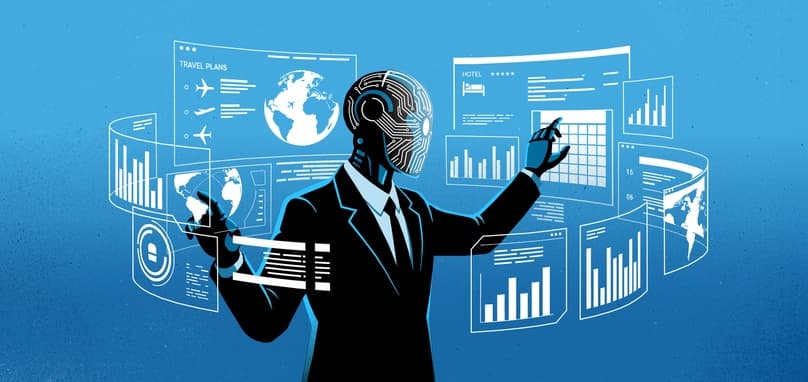
Marketing has survived every disruption the internet threw at it. Search engines did not kill marketing. Social media did not kill marketing. Mobile did not kill marketing. Each wave changed the channels, redistributed the budgets, and reshuffled who won — but the core discipline survived intact because the audience was always human.
AI agents break that assumption. For the first time, the entity evaluating your brand, comparing your product, and making the purchase decision is not a person. It is an algorithm that cannot be impressed by your creative, does not feel urgency from your countdown timer, and will never impulse-buy because your landing page hit the right emotional note.
That is not a channel shift. That is a structural demolition of how marketing has worked for decades.
Key Takeaways
- 70% of consumers welcome AI agents helping them shop, and 60% expect to use agentic AI for purchases within 12 months — creating an entirely new buyer that is immune to traditional marketing tactics
- Only 23% of organisations are scaling agentic AI capabilities, while 62% remain in experimental phases — a readiness gap that will separate winners from casualties
- AI agents evaluate brands through machine-readable data, third-party validation, and factual consistency — not creative campaigns, brand aesthetics, or emotional storytelling
- The marketing funnel is collapsing from five stages to one: a single prompt that triggers research, evaluation, and purchase without the consumer ever seeing a marketing message
- The new competitive metric is "Share of Model" — how often AI agents recommend your brand when consumers delegate decisions
What Actually Dies
Not everything in marketing is at risk. But several pillars that the industry has treated as permanent fixtures are being undermined faster than most marketers realise.
The awareness funnel dies. The traditional marketing funnel — awareness, interest, consideration, intent, purchase — assumes a human moving through stages where marketing can influence each transition. AI agents compress this into a single interaction. A consumer says "find me the best CRM for a 50-person sales team under $100/user" and the AI researches, compares, and recommends in seconds. There is no awareness stage to win. No consideration phase to nurture. No intent signal to retarget. The entire buyer journey collapses into a prompt and an answer.
Brand advertising loses its leverage. When a human shops, brand familiarity creates a cognitive shortcut — you pick the name you recognise. AI agents have no such bias. They evaluate products on specifications, reviews, pricing, and verifiable claims. A beautifully designed brand campaign that cost millions to produce has zero influence on whether ChatGPT recommends your product. The agent does not watch your TV spot, scroll past your Instagram ad, or remember your billboard.
Retargeting becomes irrelevant. The entire retargeting ecosystem — tracking pixels, cookie-based audiences, lookalike modelling — assumes a human browser to follow around the internet. AI agents do not browse. They query, evaluate, and decide. There is no session to retarget, no abandoned cart to email about, no browsing history to analyse. When AI agents handle the purchase, the surveillance-based advertising model loses its subject.
Content volume as a strategy collapses. Publishing hundreds of thin articles to capture long-tail keywords worked when humans clicked through search results. AI agents do not click through anything. They synthesise information from across the web and surface the sources that add genuine value. Content farms that rely on volume over substance become invisible to the very systems that now mediate discovery.

What Replaces It
The death of traditional marketing tactics does not mean the death of marketing itself. It means the discipline evolves — and the brands that evolve fastest gain advantages that compound over time.
Machine readability replaces creative persuasion. When the buyer is an AI agent, the first requirement is that the agent can actually parse your information. Structured data, consistent product specifications, API-accessible catalogues, and machine-readable content become the foundation of visibility. You cannot persuade an agent that cannot read your data.
Third-party authority replaces self-promotion. AI agents verify claims by cross-referencing independent sources. They weight expert reviews, industry publications, and community discussions more heavily than anything on your own website. The brands winning AI citations are the ones with deep third-party footprints — not the ones with the best "About Us" page.
Share of Model replaces share of voice. The emerging metric that matters is how often AI agents recommend your brand when consumers ask category-level questions. "What is the best project management tool?" "Which CRM works best for remote teams?" "Find me a reliable accounting platform." Your visibility in these AI-mediated conversations is the new market share — and most businesses are not even measuring it yet.
Factual density replaces emotional storytelling. AI agents evaluate brands on data: specifications, pricing consistency, feature comparisons, independent validation. Content that AI systems can cite as authoritative — buying guides with real data, comparison pages with verified specifications, research backed by methodology — becomes the highest-value marketing asset. The story still matters for human audiences. But the agent needs facts.
Speed and structure replace campaign cycles. Traditional marketing operates in quarterly campaigns, monthly content calendars, and weekly optimisation cycles. AI agents operate in milliseconds. They query, evaluate, and recommend in real time. Brands with unified, accessible data stacks respond instantly. Brands with siloed legacy systems return nothing when an agent comes looking.
The Readiness Crisis
The data on organisational readiness is stark. According to industry research, 62% of organisations remain in experimental phases with agentic AI. Only 23% are actively scaling. Meanwhile, 97% of companies expect conversational agents to be mainstream within two to three years.
That gap between expectation and preparation defines the competitive landscape for the next 18 months. The brands scaling now are building the data infrastructure, structured content, and third-party authority that AI agents require. The brands still experimenting will find themselves invisible to a buying channel that is growing at 527% year-over-year.
This is not a technology problem. It is a strategic one. Most marketing teams are still optimising for human attention in a world where an increasing share of purchase decisions are made by machines that never see their ads, never visit their landing pages, and never feel their brand story.
What Smart Marketers Are Doing Right Now
The marketers who understand this shift are not abandoning traditional channels overnight. They are hedging — maintaining what works today while building for the agentic future that is arriving faster than anyone expected.
They are auditing their AI visibility. Before you can fix what agents see, you need to know what they see. Measuring how AI platforms perceive your brand — across ChatGPT, Perplexity, Gemini, and Google AI — reveals whether you are in the conversation or absent from it entirely.
They are restructuring content for machine consumption. Not replacing human-readable content, but adding the structured data layer, the factual density, and the technical discoverability signals that AI agents need to find and evaluate their offerings.
They are building third-party moats. Investing in independent reviews, expert coverage, community presence, and brand mentions across platforms that AI agents trust. Self-promotion has diminishing returns when the buyer is an algorithm that weights independent validation above all else.
They are measuring what matters next. Adding AI citation tracking, agent referral traffic, and Share of Model metrics alongside traditional KPIs. The organisations that treat AI visibility as a core marketing metric today will not be scrambling to retrofit it tomorrow.
The Timeline Is Shorter Than You Think
This is not a 2030 problem. Target has seen 40% month-over-month growth in ChatGPT referral traffic. Some brands already attribute 10% of revenue to agentic channels. AI-referred sessions grew 527% in a single year. And 60% of US shoppers say they expect to use AI agents for purchases within the next 12 months.
The brands that treat this as a future problem will discover it is a present one. The marketing discipline is not dying — but the version of marketing that assumes a human audience, runs on creative persuasion, and measures success in impressions and clicks is being rendered obsolete by agents that operate on entirely different principles.
The future of marketing belongs to the brands that understand a simple truth: when the buyer is a machine, the rules of selling change completely. Not incrementally. Completely.