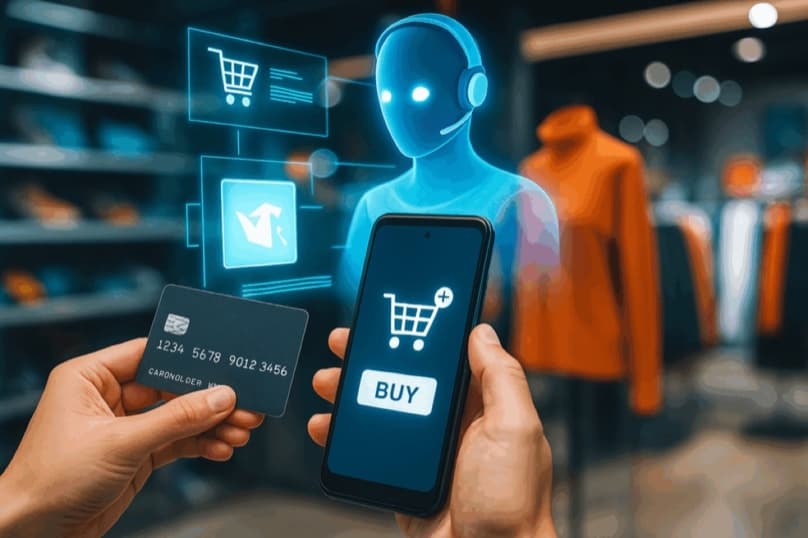
Retail has always evolved in response to how customers shop. The shift from catalogues to department stores, from malls to ecommerce, from desktop to mobile — each transition rewired the industry around a new buying behaviour. The next transition is different. The customer is no longer human.
AI agents are entering the retail journey at every stage — discovering products, evaluating options, negotiating prices, completing purchases, and managing post-purchase experiences. According to McKinsey's research on agentic commerce, this shift could generate up to $1 trillion in US retail revenue by 2030, with global projections reaching $3 to $5 trillion. These are not aspirational forecasts. They describe infrastructure that is already being built and transactions that are already happening.
This article maps the specific use cases driving agentic commerce across the full retail journey — from the moment a need forms to the moment a delivery arrives — with real examples from the companies deploying them.
Key Takeaways
- McKinsey projects agentic commerce could generate up to $1 trillion in US retail revenue by 2030, with global projections reaching $3 to $5 trillion.
- Eight distinct use cases are already in production: conversational discovery, context-aware personalisation, virtual fit analysis, dynamic price evaluation, autonomous checkout, automated replenishment, post-purchase management, and agent-to-agent negotiation.
- Google has launched agentic checkout across Search (AI Mode) and Gemini, and Amazon's "Buy for Me" agent already shops competitor websites — these are production features processing real transactions.
- Shopping-related searches on generative AI platforms grew 4,700% between 2024 and 2025, and 70% of online shopping carts are abandoned before purchase — agentic checkout eliminates every barrier that causes this.
- Retailers that win in agentic commerce are not the largest or cheapest — they are the most agent-accessible, with structured product data, accurate real-time information, and agent-friendly checkout infrastructure.
Use Case 1: Conversational Product Discovery
The most visible shift in agentic commerce is how products get found. Traditional product discovery relies on keyword search, category navigation, and filter-based browsing. A shopper types "running shoes," scans results, applies price and size filters, and clicks through pages of options. The process works, but it forces the buyer to do the thinking.
Agentic discovery inverts this. A shopper tells an AI agent "I need trail running shoes for muddy terrain, under $150, with good ankle support" — and the agent does the rest. It queries multiple data sources, evaluates product specifications, cross-references reviews, checks availability, and returns a curated shortlist.
Microsoft's analysis of agentic commerce in retail describes this as the new "front door" to retail — the AI conversation replaces the homepage. Google's Shopping Graph now connects AI agents directly to merchant product feeds, and shopping-related searches on generative AI platforms grew 4,700 percent between 2024 and 2025.
The implications are structural. If your product data was built for search filters rather than AI conversations, your products may not exist in agentic discovery. Structured attributes, natural language descriptions that reflect real use cases, and accurate pricing and availability data are what agents parse — not hero images or marketing copy. This is the same principle that determines whether AI search engines can find your business at all.
Use Case 2: Context-Aware Personalisation
Traditional personalisation shows you products based on what you browsed last week. Agentic personalisation is fundamentally different — the agent carries the customer's full context: their wardrobe inventory, calendar, budget constraints, sizing across different brands, and style preferences. When this agent approaches a store, it already knows what fits.
Consider a shopper who tells their AI assistant: "I need an outfit for a rainy outdoor wedding in Scotland next month." The agent cross-references weather data for the wedding date, the shopper's style history, available inventory, dress code norms, and budget constraints. It does not return a list of dresses. It returns a complete outfit recommendation — dress, shoes, outerwear, accessories — sized correctly and available for delivery before the event.
Bain & Company's research found that 81 percent of shoppers prefer brands that personalise their experience. But agentic personalisation goes beyond preference matching. It anticipates needs the shopper has not yet articulated. An agent tracking a customer's fitness routine might suggest replacing worn running shoes before the customer notices they need new ones.
For retailers, this means product data must include the contextual attributes that agents use for matching — occasion suitability, weather appropriateness, compatibility with other products, and real-world usage scenarios. Retailers who optimise their structured data for AI engines gain a decisive advantage in this environment.
Use Case 3: Virtual Fit and Compatibility Analysis
Returns are the hidden tax on ecommerce. Fit uncertainty drives a significant percentage of online returns, and every returned item erodes margin. Agentic commerce addresses this with vertical AI agents that specialise in fit analysis and compatibility checking.
Virtual try-on agents allow shoppers to upload a full-body image and visualise how a garment fits on their specific frame. Fit Analyser agents go further — they cross-reference a shopper's body measurements with brand-specific sizing data, accounting for the fact that a "medium" at one brand may be a "large" at another.
This extends beyond apparel. In electronics, compatibility agents verify that accessories work with existing devices. In home furnishing, spatial agents check whether a sofa fits through a doorway and matches the room's colour palette. In cosmetics, colour-matching agents recommend shades based on skin tone analysis.
The common thread is that the agent eliminates the guesswork that creates friction between browsing and buying. For retailers, enabling these agents requires detailed, machine-readable product specifications — not just marketing descriptions, but precise measurements, material compositions, compatibility matrices, and standardised attribute schemas.
Use Case 4: Dynamic Price and Promotion Evaluation
Price comparison is one of the first tasks consumers delegate to AI agents. But agentic price evaluation goes beyond finding the lowest price. The agent evaluates total cost of ownership — product price, shipping cost, estimated delivery time, return policy generosity, loyalty points earned, and available promotions — across multiple retailers simultaneously.
A shopper looking for a specific laptop model might find it listed at five different retailers. The agent calculates that Retailer A has the lowest sticker price but charges for shipping, Retailer B includes free shipping and a 10 percent loyalty cashback, and Retailer C bundles a free carrying case. The agent presents the total-value comparison, not just the price comparison.
This creates a new competitive dynamic. Retailers competing on price alone may lose to those competing on total value — faster shipping, better return policies, stronger loyalty programs, or bundled accessories. The agent's evaluation is comprehensive and instantaneous, which means every element of the purchase proposition is now a competitive variable.
For brands preparing for agentic commerce, pricing and promotion data must be structured, accurate, and machine-readable. Hidden fees, unclear shipping terms, or inconsistent loyalty point calculations will cause agents to deprioritise or skip a retailer entirely.
Use Case 5: Autonomous Checkout and Purchase Completion
The shopping cart has been the centrepiece of online commerce for two decades. Agentic checkout makes it obsolete. When an AI agent has evaluated options, confirmed fit, compared prices, and selected the best offer, it proceeds directly to purchase — applying loyalty points, selecting the optimal payment method, choosing a delivery slot, and completing the transaction without the shopper clicking a single button.
Google launched agentic checkout across Search (AI Mode) and Gemini, enabling autonomous agents to execute purchases directly on merchant websites. Amazon's "Buy for Me" agent already shops competitor websites when products are unavailable on its own platform. These are not pilot programs. They are production features processing real transactions.
Baymard Institute's research consistently shows that roughly 70 percent of online shopping carts are abandoned before purchase. Forced account creation, excessive form fields, unexpected costs, and payment friction all contribute. Agentic checkout eliminates every one of these barriers. The agent already has the shopper's payment details, shipping address, and preferences. There is nothing to fill in, nothing to create, and nothing to abandon.
For retailers, this means checkout flows must be agent-accessible. Websites that require CAPTCHA challenges, multi-step verification flows, or JavaScript-heavy cart interactions may block agent purchases entirely. The technical readiness for agentic commerce includes ensuring that checkout APIs and payment processing work for autonomous agents, not just human browsers.
Use Case 6: Automated Replenishment and Recurring Purchases
Consumable products — groceries, household supplies, pet food, personal care — follow predictable consumption patterns. Agentic commerce turns these patterns into automated purchasing. Instead of the shopper remembering to reorder, the agent monitors consumption rates, tracks inventory, and places orders at the optimal time.
This is not a simple subscription model. Subscription services deliver on a fixed schedule regardless of actual consumption. An agentic replenishment system adapts. If the household used less coffee this month because they were travelling, the agent delays the reorder. If they hosted a dinner party and consumed more olive oil than usual, the agent accelerates it.
The agent also optimises across retailers for each replenishment cycle — checking which store has the best price, fastest delivery, or a relevant promotion for each item. Loyalty is earned per transaction, not assumed per subscription.
For grocery and FMCG retailers, this shifts the competitive landscape from shelf placement and impulse buying to data accuracy and fulfilment reliability. The agent does not walk past an endcap display. It evaluates structured product data, pricing feeds, and delivery performance metrics. Retailers with clean, real-time data and reliable fulfilment win the replenishment relationship.
Use Case 7: Post-Purchase Experience Management
The agentic retail journey does not end at checkout. AI agents are increasingly managing the post-purchase experience — tracking deliveries, initiating returns, scheduling installations, requesting warranty service, and providing product setup guidance.
An agent monitoring delivery tracking might detect that a package is delayed and proactively rebook a delivery slot, notify the customer, and — if the delay exceeds a threshold — request compensation or initiate a replacement order. A post-purchase agent might send personalised setup guides within hours of delivery, tailored to the specific product variant the customer purchased.
Real-time merchandising intelligence also flows back to retailers through these interactions. When 12 percent of shoppers ask whether a summer collection comes in petite sizes, that signal reaches merchandising teams automatically — not through a quarterly survey, but in real time.
For retailers, this means post-purchase data must be as structured and accessible as pre-purchase data. Order status APIs, return policy schemas, warranty terms, and product documentation all become inputs for agent-managed customer experiences. The brands that build trust with AI agents through consistent, accurate post-purchase data earn repeat recommendations.
Use Case 8: Agent-to-Agent Negotiation
The most forward-looking use case in agentic commerce is machine-to-machine negotiation. A consumer's personal AI agent interacts directly with a retailer's AI agent to negotiate pricing, delivery terms, bundle configurations, and loyalty rewards — all within parameters set by both parties.
The consumer sets guardrails: "I want this specific TV, but I won't pay more than $800 including delivery, and I need it before Saturday." The retailer's agent evaluates margin flexibility, inventory levels, delivery capacity, and competitive pricing before making a counteroffer. The negotiation happens in seconds, reaching an agreement that works for both sides — or the consumer's agent moves on to the next retailer.
This is not science fiction. IBM's analysis of agentic commerce describes agent-to-agent interaction as the logical evolution of autonomous purchasing. SAP, Salesforce, and Shopify are all building infrastructure that enables merchant-side agents to respond to buyer-side agents with structured offers.
For retailers, this requires a fundamental rethinking of pricing strategy. Fixed prices displayed on a product page become one input among many. Dynamic pricing engines, real-time margin calculations, and structured negotiation protocols become essential infrastructure for capturing agentic transactions.
What This Means for Retailers
The eight use cases above represent a single trajectory: the progressive delegation of retail decisions from humans to AI agents. Each use case removes a friction point that exists because human shoppers have limited time, attention, and information-processing capacity. AI agents have none of these constraints.
The retailers who win in agentic commerce are not necessarily the largest or the cheapest. They are the most agent-accessible. This means:
Structured, machine-readable product data — not marketing copy optimised for human emotions, but precise attributes, specifications, and metadata that agents can parse and compare.
Accurate, real-time information — pricing, inventory, shipping times, and return policies that agents can trust. One inaccurate data point and the agent moves on to a competitor whose data is reliable.
Agent-friendly infrastructure — checkout flows, APIs, and payment processing that work for autonomous agents, not just human browsers navigating with a mouse and keyboard.
Measurable trust signals — reviews, ratings, certifications, and third-party validations that agents use as confidence inputs when making recommendations.
Frequently Asked Questions
What are the most common agentic commerce use cases in retail?
The eight primary use cases are conversational product discovery, context-aware personalisation, virtual fit and compatibility analysis, dynamic price and promotion evaluation, autonomous checkout, automated replenishment, post-purchase experience management, and agent-to-agent negotiation. Each removes a friction point that exists because human shoppers have limited time, attention, and information-processing capacity.
Is agentic checkout already available to consumers?
Yes. Google launched agentic checkout across Search (AI Mode) and Gemini, enabling agents to execute purchases directly on merchant websites. Amazon's "Buy for Me" agent shops competitor websites when products are unavailable on its own platform. These are production features handling real transactions.
How does agentic replenishment differ from subscriptions?
Subscription services deliver on a fixed schedule regardless of actual consumption. Agentic replenishment adapts — the AI agent monitors real consumption patterns and adjusts order timing accordingly. If a household travels and uses less coffee, the agent delays the reorder. The agent also optimises across retailers for each cycle, checking which store offers the best price or fastest delivery.
What data do AI shopping agents need from retailers?
AI agents require structured, machine-readable product data (specifications, pricing, availability), accurate real-time inventory information, agent-friendly checkout infrastructure (APIs and payment processing), and measurable trust signals (reviews, ratings, certifications). Marketing copy and hero images are not evaluated.
The businesses that treat agentic commerce as a future consideration are already behind. The infrastructure is live, the agents are shopping, and the retailers who are not visible to them are losing transactions they will never know about. Understanding how AI agents are reshaping commerce is the first step. You can see a preview of how AI-ready your website is with a free AI scan — 30 seconds, no signup. For the complete picture, SwingIntel's AI Readiness Audit delivers expert research across 9 AI platforms.