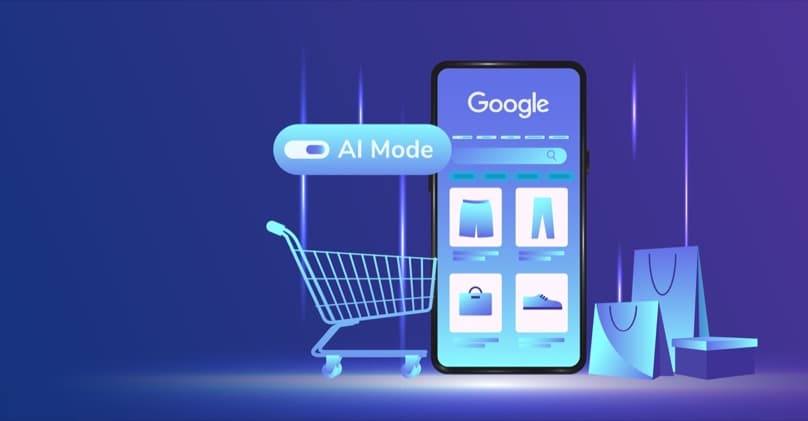
Google is no longer a search engine that happens to show shopping results. It is becoming an AI shopping agent that happens to have a search bar. The distinction matters — and for brands that sell anything online, it changes everything about how products get discovered, compared, and chosen.
Over the past two years, Google has systematically rebuilt its shopping infrastructure around AI. Product searches now trigger AI Overviews that synthesise reviews, compare specifications, and recommend specific items. The Shopping tab has been redesigned with AI-generated summaries. Virtual try-on lets shoppers see clothes on AI-generated models that match their body type. And the Google Shopping Graph — a dataset of over 45 billion product listings, with 1.8 billion updated daily — powers it all.
According to Google/Ipsos research, 49% of shoppers already use Google to discover new products. Now those discovery moments are being mediated by AI rather than traditional search results.
This is not incremental improvement. It is a structural redesign of how commerce works on the world's largest search platform. And most brands have not caught up.
Key Takeaways
- Google AI Shopping uses a Shopping Graph of over 45 billion product listings (1.8 billion updated daily) to power AI-generated product recommendations in search results.
- Schema.org Product markup with accurate pricing, GTIN codes, and specifications is the minimum requirement for appearing in AI-powered product discovery.
- Reviews and third-party signals from Trustpilot, industry publications, and independent review sites carry decisive weight in AI Shopping recommendations.
- Zero-click shopping is emerging — users complete product research and purchase decisions without visiting brand websites, as Google's AI becomes the storefront.
- Stale product data actively erodes AI trust, and rebuilding that trust takes far longer than maintaining it.
What Google AI Shopping Actually Does
Google's AI shopping experience operates across several layers, each changing how consumers interact with products.
AI Overviews for product queries. When someone searches for "best noise-cancelling headphones for commuting" or "lightweight laptop for university students," Google now generates an AI-synthesised answer at the top of the results page. This answer includes specific product recommendations with pricing, ratings, and direct purchase links — before the consumer ever reaches a traditional search result. The AI doesn't just list options; it explains why each product fits the query, drawing on product data, expert reviews, and user feedback.
The redesigned Shopping tab. Google's Shopping tab has evolved from a basic product grid into an AI-powered comparison engine. Product listings now include AI-generated summaries that distil hundreds of reviews into key takeaways: "reviewers consistently praise battery life but note the case feels cheap." Shoppers get the substance of research without doing the research.
Virtual try-on. Using generative AI, Google lets shoppers see how clothing looks on models across a range of body types, skin tones, and sizes. This feature, announced at Google I/O, reduces one of ecommerce's biggest friction points — uncertainty about fit and appearance — without the customer needing to visit a physical store.
Conversational product search. Google is increasingly allowing natural language product queries: "I need a gift for a 10-year-old who loves space and building things" returns curated, reasoned suggestions rather than keyword-matched results. This mirrors the broader shift from traditional search to AI-driven discovery that is reshaping every commercial category.
Why This Changes the Game for Brands
The traditional Google Shopping model was straightforward: list your products in Merchant Center, bid on Shopping ads, optimise your feed, and compete on price and relevance. Brands controlled their placement largely through ad spend and feed quality.
AI Shopping inverts this dynamic. When Google's AI synthesises a product recommendation, it draws on signals that go well beyond your Merchant Center listing:
Structured product data is now table stakes. Google's AI needs machine-readable product information — not marketing copy — to include you in synthesised answers. Schema.org Product markup with accurate pricing, availability, GTIN codes, brand information, and detailed specifications is no longer a nice-to-have for technical SEO. It is the minimum requirement for participation in AI-powered product discovery. Stores without it are invisible to the AI layer entirely.
Reviews and third-party signals carry decisive weight. AI Overviews don't just cite your product page — they synthesise information from review sites, comparison articles, expert roundups, and community discussions. A brand with strong third-party validation across Trustpilot, industry publications, and independent review sites will consistently appear in AI recommendations. A brand that exists only on its own domain will not.
Content depth determines recommendation depth. Google's AI can only recommend what it can understand. Product pages with thin descriptions, missing specifications, and generic marketing language give the AI nothing substantive to work with. The brands appearing in AI Shopping recommendations are the ones with detailed, factual product content — specification tables, comparison data, use-case descriptions, and buying guides that AI agents can parse and cite.
Freshness is non-negotiable. AI Shopping pulls real-time data. Stale pricing, discontinued products listed as available, or outdated inventory information doesn't just create a poor user experience — it trains Google's AI to distrust your data. And once an AI system learns to deprioritise a source, rebuilding that trust takes far longer than maintaining it would have.
The Broader AI Shopping Landscape
Google is not operating in isolation. The AI shopping race has multiple players, and each approaches the problem differently.
Amazon Rufus operates as a shopping assistant within Amazon's closed ecosystem — it can answer product questions, compare items, and guide purchase decisions, but only within Amazon's catalogue. For brands selling on Amazon, Rufus visibility is becoming critical. For direct-to-consumer brands, it's irrelevant.
ChatGPT Shopping integrates product recommendations directly into conversations. OpenAI has steadily expanded its shopping capabilities, allowing users to discover and compare products within the chat interface, complete with product cards and buy links.
Perplexity's Buy with Perplexity goes a step further, enabling one-click purchasing directly from AI-generated answers without leaving the Perplexity interface.
What makes Google AI Shopping uniquely powerful is scale and integration. Google handles the majority of product searches globally, owns the Merchant Center infrastructure, and controls both the AI Overviews and the Shopping tab. When Google decides to put AI between consumers and products, the impact on product discovery is not incremental — it is structural.
For brands, this means that optimising for AI visibility is no longer an emerging best practice. It is a commercial necessity, and Google AI Shopping is the largest single reason why.
There is also a structural concern worth naming: zero-click shopping. When Google's AI synthesises product comparisons, summarises reviews, and presents recommendations directly in the search results, users increasingly complete their product research — and sometimes their purchase decision — without ever visiting a brand's website. Google's AI becomes the storefront. Brands become suppliers to an AI-mediated experience they do not control. The old funnel model doesn't apply — brands need to think in terms of contextual presence across AI surfaces, not conversion paths on their own site.
What Brands Should Do Now
The businesses that will capture visibility in Google AI Shopping are the ones building the right foundations today.
Audit your structured data. Every product page needs complete Schema.org Product markup — name, description, brand, price, availability, GTIN, reviews, and detailed specifications. Test with Google's Rich Results Test and fix every error. This is the single highest-impact action for AI Shopping visibility.
Invest in Google Merchant Center. Ensure your product feed is complete, accurate, and updated in real time. The Merchant Center feed is the primary data source for Google's AI Shopping features. Missing fields, stale data, or feed errors directly reduce your AI visibility.
Build citable product content. Move beyond marketing copy. Publish detailed buying guides, specification comparisons, and category explainers that Google's AI can draw from when generating recommendations. The AI Citation Playbook provides a framework for creating content that AI systems want to reference.
Strengthen third-party presence. Google's AI cross-references your claims against independent sources. Invest in review platform profiles, industry directory listings, and earned media coverage. Your Merchant Center feed gets you listed. Third-party signals get you recommended.
Monitor your AI visibility. Track whether Google AI Overviews include your products for relevant queries. Monitor how AI engines surface your brand across platforms — not just Google, but ChatGPT, Perplexity, and others. The brands that measure AI visibility can optimise for it. The brands that don't are flying blind.
The Bottom Line
Google AI Shopping represents the most significant change to product discovery since the introduction of Google Shopping itself. The shift from "search and browse" to "ask and receive a recommendation" is not theoretical — it is live, scaling, and already changing which brands consumers see.
The brands that win in this environment are not the ones with the biggest ad budgets. They are the ones whose product data is structured enough for AI to parse, whose content is authoritative enough for AI to cite, and whose third-party presence is strong enough for AI to trust.
Frequently Asked Questions
What is Google AI Shopping?
Google AI Shopping is an AI-powered product discovery experience built into Google Search. It uses a Shopping Graph of over 45 billion product listings to generate AI-synthesised product recommendations, comparisons, and reviews directly in search results, AI Overviews, and the redesigned Shopping tab.
Do I need Schema.org markup to appear in Google AI Shopping?
Yes. Schema.org Product markup with accurate pricing, availability, GTIN codes, brand information, and detailed specifications is the minimum requirement. Without structured product data, your products are invisible to the AI layer that powers Google AI Shopping.
How does Google AI Shopping differ from traditional Google Shopping?
Traditional Google Shopping relied on Merchant Center feeds and ad bids. AI Shopping synthesises product recommendations by drawing on structured data, reviews, third-party signals, and expert content — meaning brands can no longer control placement through ad spend alone.
Does Google AI Shopping cause zero-click shopping?
Yes. When Google's AI summarises reviews, compares products, and presents recommendations directly in search results, users increasingly complete their research and purchase decisions without visiting brand websites. This makes being cited in the AI recommendation more valuable than driving a single click.
AI agents are reshaping commerce across every platform. Google AI Shopping is where the largest wave of that reshaping is happening right now. The question for every brand that sells online is simple: when Google's AI recommends a product in your category, is it recommending yours? Check your AI visibility to find out.