
You ask ChatGPT to recommend a provider in your industry. A competitor shows up. You don't. You try Perplexity. Same result. Gemini? Your competitor again — sometimes by name, with a link to their website.
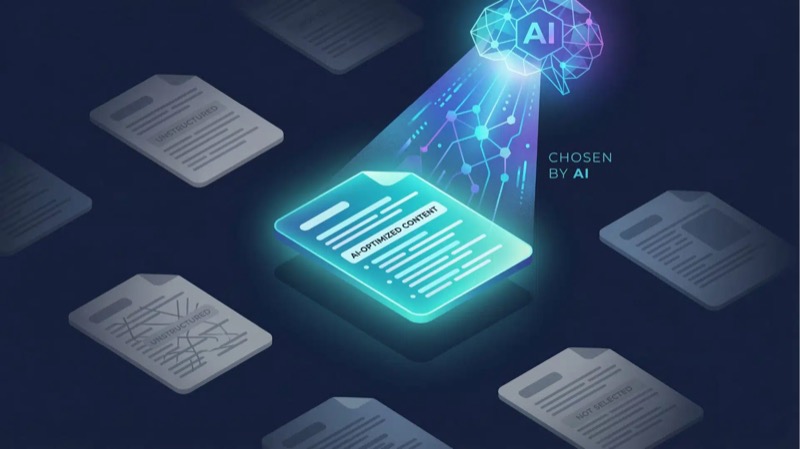
This is not a coincidence, and it is not random. AI search engines are systematically choosing your competitors over you because their websites meet specific criteria that yours currently does not. The gap is structural, not subjective — and once you understand what drives it, it becomes fixable.
Key Takeaways
- AI search is binary — either your brand is cited in the answer or it is invisible. There is no "page two" equivalent in AI search.
- Five structural reasons competitors get cited: content structured for machine reading (Organisation schema at 25-34% of cited pages), direct question-answer formatting, stronger authority signals (domains with 32,000+ referring domains are 3.5x more likely to be cited), presence across the platforms AI models query, and stronger technical foundations.
- Domains with active profiles on Reddit and Quora have approximately 4x higher citation rates, and domains on review platforms have roughly 3x higher citation rates.
- The fix follows a clear timeline: audit your position in weeks 1-2, fix structural foundations (schema, content restructuring, robots.txt) in weeks 3-4, build authority signals in month 2, and expand content clusters in month 3.
- Changes to structured data and content format can produce measurable AI visibility results within weeks, not months.
AI Search Does Not Work Like Google
The first thing to understand is that AI search engines do not rank websites on a results page. They synthesise answers from multiple sources and decide — in real time — which brands deserve to be named, cited, and recommended.
Gartner projects that traditional search engine volume will drop 25% by 2026 as AI-powered alternatives capture demand. When someone asks ChatGPT "What's the best accounting software for small businesses?" or asks Perplexity to compare CRM platforms, the AI does not return ten blue links. It returns an answer — and either your brand is in that answer, or it is not.
This binary dynamic is why the competitor gap feels so jarring. In traditional search, you might rank on page two while a competitor sits on page one. In AI search, there is no page two. You are either cited or invisible.
Five Reasons Your Competitors Are Getting Cited Instead of You
1. Their Content Is Structured for Machine Reading
AI models do not browse your website the way a human does. They parse structured data, extract entity signals, and look for machine-readable markup that confirms what your business is, what it does, and why it is authoritative.
Your competitors likely have Organization, Article, and FAQ schema markup implemented across their key pages. A Semrush study of 5 million AI-cited URLs found that pages cited by ChatGPT Search had Organization schema at 25% — and pages cited by Google AI Mode had it at 34%. If your pages lack this markup, AI systems cannot confidently identify your brand, and they default to competitors whose identity is machine-verifiable.
2. They Answer Questions Directly
AI systems favour content that provides clear, citable answers in the opening sentences of each section. If your competitor's page on "how to choose a financial adviser" leads with a direct answer and supporting evidence, while your page buries the answer below three paragraphs of introduction, the AI will cite theirs.
This is not about word count or content quality in the traditional sense. It is about citability — structuring content so AI systems can extract and attribute specific claims. Headers that mirror how people phrase questions, direct answers within the first two sentences under each header, and explicit source attribution for data claims all increase the likelihood of citation.
3. They Have Stronger Authority Signals
AI platforms weight authority differently than Google, but authority still matters. The signals that drive AI citations include quality backlinks from authoritative publications, consistent brand mentions across trusted platforms, and presence on review sites like G2, Trustpilot, and Capterra.
Research shows that domains with over 32,000 referring domains are 3.5x more likely to be cited by ChatGPT than those with fewer than 200. Domains with active profiles on review platforms have roughly 3x higher citation rates. Your competitors may not have better products — but if they have more third-party validation that AI systems can verify, they get cited first.
4. They Exist in the Places AI Models Look
AI search engines do not rely solely on crawling websites. They pull information from training data, knowledge graphs, real-time web retrieval, and platform-specific sources. Your competitors may appear in AI answers because they have built presence across the ecosystem that AI models draw from.
This includes mentions on Reddit and Quora (domains with millions of mentions on these platforms have roughly 4x higher citation rates), inclusion in industry listicles published by authoritative sites, and presence in knowledge bases that AI models reference during retrieval. If your brand only exists on your own website, AI systems have one source to draw from. If your competitors are mentioned across dozens of trusted platforms, AI systems have corroborating signals that justify citation.
5. Their Technical Foundation Is Stronger
Technical SEO factors that many businesses treat as housekeeping — page speed, URL structure, mobile optimisation, crawlability — correlate directly with AI citation rates. Pages with faster load times generate higher engagement metrics, which AI models use as quality signals. Shorter, descriptive URLs (17-40 characters) appear in AI citations at significantly higher rates than cryptic or bloated URLs.
If your competitors' sites load in under 2.5 seconds, serve clean HTML to AI crawlers, and use descriptive URL slugs, they have a technical advantage that compounds across every page. Meanwhile, if your robots.txt blocks AI crawlers, your pages rely on client-side JavaScript rendering, or your site throws CAPTCHA walls at AI user agents, you may be actively preventing the visibility you want.
How to Close the Gap
The competitor advantage in AI search is not permanent. It is a reflection of who adapted first. Here is a priority framework based on what actually drives AI citation decisions:
Week 1-2: Audit your current position. Before fixing anything, measure the gap. Check which queries surface your competitors in AI answers and whether your brand appears at all. Manual spot-checks are unreliable — AI responses vary by query phrasing, user context, and timing.
Week 3-4: Fix structural foundations. Implement Organization, Article, and BreadcrumbList schema on your top 10 pages. Restructure content to lead with direct answers under question-format headers. Ensure AI crawlers (ChatGPT, Perplexity, Claude, Google AI) are not blocked by your robots.txt or WAF configuration.
Month 2: Build authority signals. Pursue mentions in industry publications, contribute expert commentary, and ensure your brand has profiles on relevant review platforms. Target listicles that AI engines already cite — getting included in a list that ChatGPT references is more valuable than ranking for a keyword that AI bypasses entirely.
Month 3: Expand and measure. Create content clusters around the questions your target audience asks AI engines. Monitor citation rates across platforms. AI visibility shifts faster than traditional rankings — changes you make today can produce measurable results within weeks, not months.
Stop Guessing, Start Measuring
The most dangerous response to seeing competitors in AI search is to guess why they appear and you don't. The reasons are specific, measurable, and often technical — not subjective judgments about content quality or brand strength.
SwingIntel's free AI Readiness Scan checks 15 signals across structured data, content clarity, and technical signals in under a minute — giving you a concrete score to benchmark against. For the complete picture, the AI Readiness Audit includes live citation testing across nine AI platforms, automated competitive benchmarking that surfaces your top competitors and how they compare, and a strategic roadmap showing exactly what to fix and in what order.
Frequently Asked Questions
Is AI search visibility separate from Google SEO, or do they overlap?
They overlap significantly but are not identical. Many SEO fundamentals — structured data, content quality, technical health — also drive AI visibility. However, AI engines place additional weight on entity signals, knowledge graph presence, content formatted for machine extraction, and off-site mentions across review platforms and community sites like Reddit. A site can rank well on Google but be invisible to AI engines if it lacks these additional signals.
What is the single most impactful thing I can do to start appearing in AI search?
Add Schema.org Organisation and Article markup to your top 10 pages and restructure content to lead with direct answers under question-format headings. This is the lowest-effort, highest-impact change because it immediately makes your content machine-readable to AI agents. A Semrush study found that pages cited by ChatGPT Search had Organisation schema at 25%, suggesting most competing pages still lack it.
How long does it take to close the AI visibility gap with competitors?
Structural improvements like schema markup and content restructuring can produce measurable results within weeks. Building authority signals through industry publications and review platform profiles takes 1-3 months. Training data presence — which builds over years of consistent publishing — is the slowest gap to close, but real-time retrieval improvements (structured data, freshness, citability) can compensate while you build your long-term content footprint.
Your competitors are not getting cited because they are better. They are getting cited because their websites give AI systems what they need to justify a recommendation. That is a gap you can close — but only if you know where it exists. Start with a free AI readiness scan to measure the gap, or get the full competitive picture with an AI Readiness Audit including live citation testing across nine platforms.