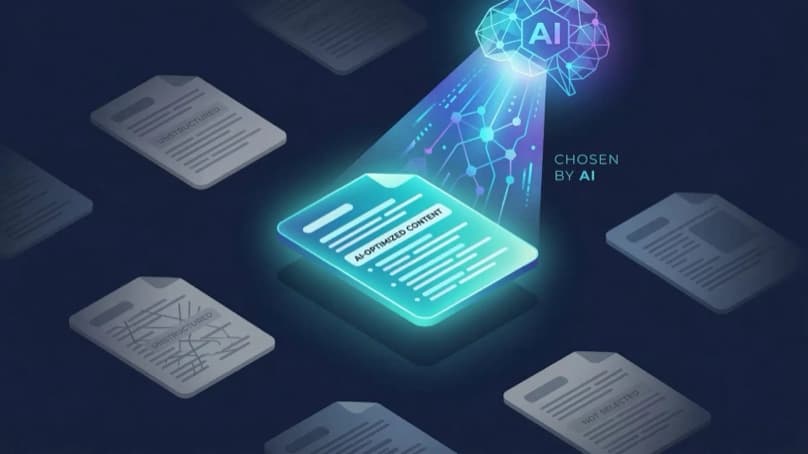
AI search optimization is no longer optional — it's becoming the primary way potential customers discover businesses online. ChatGPT, Perplexity, Gemini, Claude, Google AI Overview, Grok, DeepSeek, Microsoft Copilot, and Meta AI are reshaping how people find answers, and the businesses that adapt now will own the next decade of digital visibility.
The shift is accelerating faster than most business owners realise. Understanding where AI search is heading — and what to do about it — is the difference between leading your market and disappearing from it.
Key Takeaways
- Gartner predicts traditional search engine volume will drop 25% by 2026 as users shift to AI assistants — the businesses adapting now are building compounding advantages.
- AI search is fragmented across ChatGPT, Perplexity, Gemini, Claude, and Google AI Overview, each with different data sources and citation patterns — optimising for one platform is not enough.
- Only 33% of websites implement structured data markup, giving early adopters a significant AI visibility advantage over the majority of competitors.
- The five-step playbook is: audit AI readiness, fix structured data first, rewrite key pages for citability, test across multiple AI platforms, and monitor quarterly.
- AI search optimization compounds like early SEO did — businesses that establish visibility now are training AI systems to recommend them in the future.
Where Is AI Search Heading?
AI-powered search is moving from a novelty to a default behaviour. Gartner predicts that by 2026, traditional search engine volume will drop by 25% as users shift to AI assistants and conversational agents. That prediction is playing out in real time.
Three trends are defining this shift:
Multi-platform fragmentation. There's no single AI search engine — users are spread across ChatGPT, Perplexity, Google Gemini, Claude, and Google AI Overview. Each platform has different data sources, different citation patterns, and different strengths. A business that's visible on ChatGPT might be completely absent from Perplexity. Optimising for one platform isn't enough.
Zero-click answers are the norm. AI agents don't send users to a list of links — they synthesise a direct answer. If your business is cited in that answer, you get the recommendation. If it's not, the user never knows you exist. There's no "page two" in an AI-generated response, and there's no click-through to optimise. You're either in the answer or you're invisible.
AI agents are learning in real time. These platforms continuously update their knowledge bases. Websites that are consistently well-structured, factually clear, and technically accessible build compounding visibility over time. The inverse is also true — businesses that delay optimisation fall further behind with each passing month.
Why Most Businesses Are Already Behind
The uncomfortable truth is that most websites were built for a world that's disappearing. They're optimised for Google's traditional algorithm — keywords, backlinks, meta descriptions — but structurally invisible to AI agents.

Here's what AI agents actually need from your website:
Structured data markup. JSON-LD schemas like Organization, Product, FAQ, and Article give AI agents machine-readable context about your content. Without structured data, AI agents have to infer what your page is about — and they often get it wrong or skip you entirely. Only 33% of websites currently implement structured data markup, which means early adopters have a significant advantage.
Citable, factual content. AI agents extract specific statements to build their answers. "We're an industry-leading provider of innovative solutions" gives an AI nothing to cite. "We serve 2,400 businesses across 15 countries with automated invoice processing" is a factual claim an AI agent can actually use. The difference between vague marketing copy and citable content determines whether you appear in AI-generated answers.
Technical accessibility. Many AI crawlers don't execute JavaScript. If your critical content lives behind client-side rendering, AI agents may never see it. Server-rendered content, proper meta tags, fast load times, and clean canonical URLs are the technical foundation of AI search visibility.
If you're unsure where your website stands on these dimensions, a free AI readiness scan gives you a scored assessment in 30 seconds.
How to Stay Ahead: A Practical Playbook
Staying ahead in AI search isn't about chasing algorithms — it's about building a website that any AI agent can understand, trust, and cite. Here's a concrete framework.
Step 1: Audit Your AI Readiness
You can't improve what you don't measure. Before making changes, establish a baseline across three areas:
- Structured data coverage — which schemas are implemented, which are missing?
- Content citability — can AI agents extract clear, factual statements from your key pages?
- Technical signals — is your site crawlable by AI agents, not just traditional search crawlers?
SwingIntel's AI Readiness Audit runs 24 checks across structured data, content clarity, and technical signals, tests your citations across 9 AI platforms, and benchmarks you against competitors — giving you a complete picture rather than guesswork.
Step 2: Fix Structured Data First
Structured data delivers the highest impact for the least effort. Start with these schemas:
- Organization — tells AI agents who you are, where you're located, and how to categorise your business
- Product or Service — defines what you sell with prices, descriptions, and availability
- FAQ — directly matches the question-and-answer format that AI agents use to build responses
- Article — marks your content with author, publication date, and topic metadata
Implement these as JSON-LD in your page headers. Validate with Google's Rich Results Test and Schema.org's validator.
Step 3: Rewrite Key Pages for Citability
Review your homepage, service pages, and about page through the lens of AI extraction. For each page, ask: what specific, factual statement could an AI agent pull from this?
Transform vague claims into citable facts. Define industry terms inline — AI agents extract definitions. Use Q&A formatting where it fits naturally. Write sentences that stand on their own when extracted from context, because that's exactly how AI agents will use them.
Step 4: Test Across Multiple AI Platforms
This is where most businesses stop short. Testing on ChatGPT alone misses the full picture. Each AI platform has different data sources and citation behaviours:
- ChatGPT draws from web browsing and training data
- Perplexity emphasises real-time web search with source citations
- Google Gemini integrates with Google's knowledge graph
- Claude relies on training data and web access for factual claims
- Google AI Overview pulls from Google's search index and featured snippets
A business that's cited by Perplexity might be invisible to ChatGPT, and vice versa. Testing across all platforms reveals where your gaps are and where your strengths lie.
Step 5: Monitor and Iterate
AI search visibility isn't a one-time fix — it's an ongoing practice. AI platforms update their models, competitors optimise their content, and user query patterns evolve. Build a quarterly cadence: audit, optimise, test citations, measure progress, repeat.
The Compounding Advantage of Moving First
The most important thing about AI search optimisation is that it compounds. AI agents learn which sources are reliable, well-structured, and frequently cited. Businesses that establish AI visibility now are training these systems to recommend them in the future.
This is the same dynamic that played out in early SEO. The businesses that invested in search optimisation in 2005 built domain authority that took competitors years to match. AI search is at that same inflection point — early movers build advantages that are exponentially harder to replicate later.
The difference is that AI search is moving faster. The window to establish a first-mover advantage is measured in months, not years.
Frequently Asked Questions
Is AI search optimization different from traditional SEO?
Yes. Traditional SEO focuses on backlinks, keyword targeting, and page-one rankings. AI search optimization focuses on structured data, content citability, entity recognition, and technical accessibility for AI crawlers. The two disciplines overlap — structured data and clear content help both — but AI search has distinct requirements that traditional SEO does not address, including multi-platform citation testing and factual density.
Which AI search platform should I optimise for first?
Do not optimise for just one platform. ChatGPT, Perplexity, Google Gemini, Claude, and Google AI Overview each draw from different data sources and have different citation behaviours. A business cited by Perplexity might be invisible to ChatGPT. Start with structured data and citable content — these foundations improve visibility across all platforms simultaneously.
How quickly does AI search optimization show results?
Structured data changes can show results within days for platforms like Perplexity that fetch live web data. Broader AI visibility improvements typically become measurable within four to eight weeks. The compounding effect means early improvements reinforce themselves — each citation and each mention strengthens the signals AI engines already trust about your brand.
Your competitors are either already optimising for AI search or they will be soon. The question isn't whether AI search visibility matters for your business — it's whether you'll build your advantage now or spend years trying to catch up. Start with a free AI readiness scan to see exactly where you stand.